
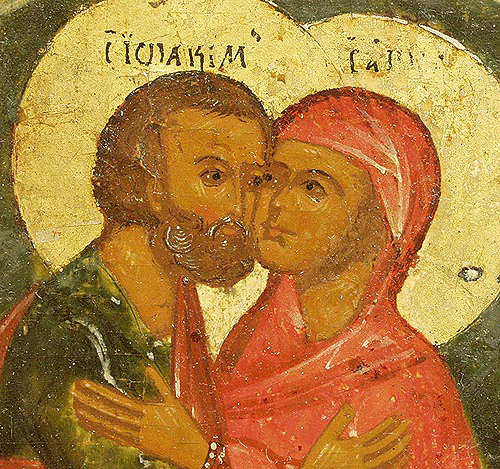
Can marriage heal the individual from being consumed by the self? Does marriage extend into eternity? Are these the same question? To move from time to eternity is to enter into the Life of the Trinity where all things moves from the self to the “Other” as the center of existence. The life of the Trinity is a continual outpouring for the Other; the Father freely pours out His love for the Son, the Son freely accepts and the Holy Spirit joins in the eternal dance. This continual extension of eros between the Divine Persons of the Trinity leaves no room for space or time between them; eternity is the absence of time, the tick of the watch. When the couple offers their marriage to God the Kingdom is revealed; marriage becomes sacrament where “man enters the realm of eternal life”. 1
In order to defend the definition of marriage as a joining of man and woman, the term “Marriage is a sacrament” has been thrown around for decades, but what then is a sacrament? Sacrament is the Latin translation for the New Testament Greek mysterion, mystery. “In the proper religious sense of the term, “mystery” signifies not only hiddenness but disclosure. The Greek noun mysterion is linked with the verb myein, meaning ‘to close the eyes or mouth.’”2 In the New Testament world when someone joined a religious cult the other members would guide the person through a religious rite where the mysteries of the cult were revealed. A mystery cannot be called such unless it is revealed.
In Ephesians 5 Saint Paul explicitly uses the pagan Greek mysterion to describe marriage in the Church and initiates the term into Christianity: “Τὸ μυστήριον τοῦτο μέγα” (This is a great mystery)3: “For this reason a man shall leave his father and mother and be joined to his wife, and the two shall become one flesh. This is a great mystery, but I speak concerning Christ and the church.” (Eph 5:31-32) Paul unites the mystery of two becoming one flesh to the union of Christ with his bride, the Church. As the body of Christ, the Church itself is the sacrament of God, revealing Christ in our midst, for where the body is, there Christ is as the head.4 When the Spirit unites the couple in marriage within the Body of Christ any distance of space or time between the two persons are filled with the Divine.5 With no room for the tick of the watch the couple “enters the realm of eternal life”.6 The man and woman enter into eternity through their love for one another, the very substance of the sacrament.7
Because marriage is sacrament it is also symbol in the full sense of this ancient term. Before the Enlightenment when the divine was exiled from our understanding of symbol the Ancient Greek word symbolos meant “to put two things together.” The two things put together are both present: the temple in Jerusalem was a symbol of God’s presence and God was truly there; the same could be said for the pagans who made a symbol of Baal out of bronze and believed Baal to be there. Symbols offer a unique knowledge of the thing symbolized that cannot be gained anywhere else as Father Alexander Schmemann explains, “For it is the very nature of symbol that it reveals and communicates the “other” as precisely the “other,” the visibility of the invisible as invisible, the knowledge of the unknowable as unknowable, the presence of the future as future. The symbol is means of knowledge of that which cannot be known otherwise, for knowledge here depends on participation—the living encounter with and entrance into that ‘epiphany’ of reality which the symbol is.”8 The marriage of the couple symbolizes Christ and the Church poured from His side and united with Him as the Eschaton. The couple receives a uniquely intimate knowledge of the union of Christ and the Church by participating in the mystery. Through the symbol of marriage the couple enters into the eternal reality of Christ united with his bride in the Kingdom.
In order for marriage to be a unification we cannot only have a single person; Eve was taken from Adam’s side that she might be united with her other half. Bishop Anthony Bloom remarked, “[Adam] looks at her and says: ‘I am ISH.’ She is ‘ISHA’, the same being in the masculine and the feminine. it is not to oppose different creatures, it is a femininity on the one hand, the masculinity on the other hand, that are one person. They are one personality in two persons.” 9 When Adam saw Eve he gazed upon the Image of God before him; she revealed his calling to become God’s likeness by grace as a “partaker of the Divine Nature” (1 Peter). Eve liberated Adam from being lost in self reflection and became his pathway to Theosis. God formed the human being into two persons that humanity might have the opportunity die to self and become truly personal beings in communion like the Holy Trinity.
A third person brings the couple into full participation of the life of the Trinity. Before there was a formal Christian marriage service, in the early church the Episcopos (1 Timothy 3) or bishop would bless the couple’s marriage at communion during the Liturgy.10 This was no outward reenactment, the faithful understood themselves to be standing in Heaven itself when they gathered as the Body of Christ. The bishop who presided over the liturgy was the symbol of Christ, where the body of Christ is so too Christ the head of the body is in our midst. Father Schmeann explains how the bishop revealed Christ, “We called this relationship [of symbol] an epiphany. ‘A is B’ means that the whole of A expresses, communicates, reveals, manifests the ‘reality’ of B (although not necessarily the whole of it) without, however, losing its own ontological reality, without being dissolved in the other.”11 The bishop would reveal Christ uniting the couple so that the two could forsake their existence as isolated individuals to enter into the communal Life of the Kingdom.
The Christian couple is joined in God Himself as the ever present third person. The Holy Spirit, the minister and the ecclesia bless the marriage with their witness; husband cannot bless wife nor wife husband without forming a closed loop that is isolated from the rest of the world. And isolated eros is not the outreach of love but a return to self-centeredness. For each person in relationship to transcend themselves away from an obsession with their muse they must continually reach outside of themselves to the beloved and join the mystery of the beloved’s unique relationships with all who are personal. The Father is not locked into a closed loop with the Son but also sends forth the Spirit and rejoices in the unique relationship held between Son and Spirit. Likewise the Christian couple is never limited to two persons; the spouse rejoices and wonders at their beloved’s love for God and unique otherness of their dance with the Spirit. According to Saint John Chrysostom love unites the lovers with one another and God.12 The Trinity is an eternal dance; with three there is an element of unpredictability and eternal wonder – who shall be the partner for the next dance? When Saint Paul presents the image of the wedding of Christ and the Church he keeps all three roles in his image with Christ as groom, the Church as the bride and Christ as the friend of the bridegroom who prepares the bridal chamber. The friend of the bridegroom blesses the unique relationship and provides an “other” from which to distinguish the couple, just as the Holy Spirit provides contrast to the unique relationship between the Father and the Son; the relationship between Father and Son is begotten while the relationship between Father and Holy Spirit proceeds. God provides contrast as other for every Christian couple and a third for each person to surrender the other to that they might be transformed into the Image of the self emptying God.
In the 4th century the bishop with the golden mouth, John Chrysostom saw many couples united and witnessed, “When husband and wife are united in marriage, they form an image of no earthly reality but of God Himself.”13 By giving their life for the other the lonely self is transformed into the wonder of a person in love. The individual is one centered on the biological and physical self, whereas the person transcends the biological and physical.14 The person is the “I” who only exists in relation to “you” as other, without the other the person returns to being an isolated individual. The couple as well exists only in relationship; no isolated individual can call themselves a “couple”. Thus the love for the other symbolizes the true and real presence of Christ and the Church, the eternal self giving of heaven and earth.
A third person is always welcome into the dance. Children are a blessing of marriage, more persons to love. Even without children the couple can be fully immersed in eternal Triune love that the marriage might reach its full perfection and telos.15 In the Jewish tradition marriage was only blessed if it involved children to carry on the memory of the couple perpetually in history. Saints Joachim and Anna were derided by their Jews neighbors for being childless. One year their sacrifice was even rejected by a priest in Jerusalem.16 The two continued in prayer asking God for a child to bring an end to their shame. Saint Anna promised the child to God. The Lord heard them and joined their faithful love to the road of salvation; Saint Anna gave birth to Mary, the Mother of our Savior. The Savior would then redefine marriage transforming it from an historical tradition into an eternal one. The Son of God joined Himself to our human nature in the Incarnation revealing that the human being’s rightful citizenship was in eternity. Man united to God in the God-man proved that the human person need no longer worry about maintaining their memory forever on this earth that will pass away. Joined to the King of Eternity the person and their memory live eternally without the need of biological children to carry on an earthly memory. What then is the blessing of children? Children are a mirror revealing the Image of God just as Eve was for Adam. When man and wife are united in God a unique bond is formed out of the love of two free persons. Children are the unique result of this bond just as creation is the unique result of the love of the Trinity.17 We can point to Cain, Abel and Seth as specific manifestations of the love between Adam and Eve, and Adam and Eve can as well when they gaze at their children. Loving our children turn us from self centeredness and place us upon Christ’s cross to join Him in His resurrection.
How should we approach contraception? The Orthodox Church condones non-abortive methods of contraception, though it has a wide variety of views on their use and should be a conversation with one’s spiritual mentor. My friend Abbot Tryphon of Vashon Island in Seattle offers some pastoral counsel, “Birth control should never be based on selfish motives, or the desire to live a more comfortable lifestyle. This life is not meant for personal gratification, nor personal gain, but that we might give glory and worship to God in all we do.”18 The view that some methods of contraception are non-abortive do bring up personal questions for me that deserves its own paper, namely where does personhood start? I don’t mean this as a judgement of anyone’s use of contraception or anyone who has struggled with a miscarriage. If life starts when a sperm physically mixes with an egg as is normally said, is that where personhood starts? There is so much mystery in marriage and sex – intimacy, breath in spirit shared together, emotions, communications only meant for the other, all of which are personal; if we limit the beginning of a new person to the moment of biological interaction, sperm with egg, do we not risk reducing the mystery of the person-hypostasis formed to a biological entity and disregard the soul? This same question can be applied to the church as the image of the married couple. When did the church start? At Pentecost, at the cross when the blood and water flowed from Christ side or when God said, “Let there be light”? It is hard to pin down the beginning of eternal beings. It is a great wonder in a marriage to participate with God in the formation of another person as an eternal mystery. Saint Paul even counsels his disciple Timothy that “women will be saved through childbearing” if she continues in faith and love (1 Tim 2:15).
Christ’s presence in the Christian marriage is the continual chance to enter into Christ’s death and thereby be resurrected with Him. In the Orthodox wedding service no vows are given, rather royal crowns are placed on the couples head to “crown them with glory and honor”.19 They are crowned with the victory of the martyrs who gave their life as witness to the resurrection in the Roman coliseums and obtained heavenly crowns. Saint Procopius’ message to couples is invoked during the crowning that exhorts the spouses to attain to the marriage in Heaven through martyrdom.20 These crowns do not necessarily imply suffering but orient the couple to the One who carries both Cross of the Gospel and Crown of victory.21 If the couple dies with Christ then they are also raised with Him in the Kingdom and their love is projected into eternity. Their baptism into Christ’s death does not stop at the wedding service; they continue to die to self when they love the other as they wish to be loved, raise children together, and make sacrifices for the other. Marriage is surrounded with refreshing moments of second baptism just like the tears of confession. The couple joins Christ in being poured out for the salvation of His beloved (Phil 2:4). Bishop Athanasius used to say, “God wonders at the faith of someone who is willing to be poured out as they give Him hope for the salvation of the world.” When we are poured out for the other in love the salvation of the world draws a little bit nearer. Eternity becomes ever more tangible.
As Christ was poured out to take on our flesh, so the husband is emptied of himself to become one flesh with his wife. The couple united in Christ experiences the promise God gave to humanity in the Garden that “the two will become one flesh.” (Gen 2:24) Rejoined as one flesh they once again experience the joy of the Garden if they freely surrender the egoism of their old man and accept their united flesh. The Holy Spirit moves man’s center from himself to the other through the love of the one flesh.22 Saint Paul exhorts husbands to love his wife as his flesh, removing the distance between the lover and the beloved, “So husbands ought to love their own wives as their own bodies; he who loves his wife loves himself. For no one ever hated his own flesh, but nourishes and cherishes it, just as the Lord does the church. For we are members of His body, of His flesh and of His bones. ‘For this reason a man shall leave his father and mother and be joined to his wife, and the two shall become one flesh.’” (Eph 5: 28 – 31) To Paul the unity of man and woman in one flesh is not merely poetic or a nice idea but a living reality embodying the reality of Christ and the Church. To “become one flesh” is a tangible reality of skin and matter. The husband cherishes his wife as his own being and this gives him life. Instinct would say, “I must feed myself, breathe for myself” and yet Paul says, “breathe for the other for she is your breath.” This has been the paradoxical truth since God breathed His Divine Spirit into our lungs when we were but dust, our very life is the Other.
The faith or lack thereof of one partner does not hinder the other partner’s life or cut them off from Heaven. Commenting on Saint Paul’s exhortation to the Corinthians to stay married to their unbelieving spouse in 1 Corinthians 7, Saint John Chrysostom says that the believing wife joined to an unbelieving husband is under no threat to her faith and even shows that she is truly free when she “shows that her spirit is free even though she is subject to a master.”23 Dying to self does not mean slavery to another’s passions, rather it means dying to our passions and desires that enslave us, the true evil masters that can be falsely attributed to the spouse. The spouse emptied of their selfish passions can even be freely united to someone who is still a slave to their own sin, the passions of the one enslaved has no affect on the other who is dead to sin. Saint John does not in anyway condone an abusive marriage, nor advise that a spouse stay in an abusive relationship in hopes that the other would be converted to Christ. God knows how to save all of His children and no single person is their spouse’s only hope. The one truly emptied of their egoism is void of any savior complex and has no codependent need to stay in an abusive relationship. When both spouses are willing to be offered for the other, the mystery of Christ and the Church is revealed in the fullness of its wonder.
In Disney’s Aladdin, Aladdin dons the dress of a prince and begins to woo Jasmine upon a flying carpet with the words, “I can show you the world.” Every princess longs to see the world revealed in all of its beauty. Does marriage only reveal this world that will pass away? Following the thought of Saint Augustine the West has affirmed that marriage is only for this life and sexual union only for procreation. In the west symbols and mysteries came to mean that the higher reality was unaffected by the lower.24 But in the East when two things are joined as a real symbol both are affected. A is B. God died. The marriage of man and wife reveals Christ united to His body and body and head are life for the other in both marriage and the Church. Saint Silouan of Mount Athos said to Saint Sophrony, “blessed is the soul who loves her brother, for my brother is my life” and he wasn’t referring to a sympathetic pain when his brother hurt but that he truly lived and died with his brother. Marriage is not an optional lower reality but truly the mystery of Christ united to the church. To reduce marriage to a lower plane is to divorce Christ from His body and the death of salvation. In our Eastern understanding all sacraments reveal things to be what they truly are: realities of the resurrection in “the Kingdom, the world to come.”25 Christ is the Resurrection and the Life (John 11:25) and He unites the couple into the Eschaton where the new heaven and the new earth await. The Kingdom of Heaven is not in a land far away in another life but at hand (Matthew 3:2). Christ grants Jasmine’s wish to see the world with Aladdin here and now. When Jacob wrestled with God he found the gate of heaven and erected an altar of stone where it set (Genesis 28); the couple united in God finds the door to eternity and erect an altar with their love.
Marriage is a door into the Kingdom. No longer is marriage a historical act just for making children to carry on a legacy or populate God’s world with more persons. This earth will pass away and with it all legacy and earthly progress of “building a better world.” Only if marriage reaches into eternity does it remain a meaningful union; anything that passes away from eternity back into non-being forever loses its worth. Christ blessed the wedding at Cana with the presence of Eternity Himself and transformed water into wine giving birth to a new eternal meaning for marriage just as blood and water would pour from His side giving birth to the Church. God wastes nothing and marriage is no exception, all that God has made is good and revealed to be what it truly is in the Kingdom. In a world where no husband lays down his crown to glorify his wife we would not be able to understand how Christ makes His bride glorious for we would have no specific reality to point to but only general abstractions. This is what sacrament is: revealing all that matters to truly matter unto the ages of ages. God is love and love is never wasted; the couple united to Christ in love is “the Kingdom of Heaven at hand.”
- Meyendorff, John. 1975. Marriage: An Orthodox Perspective. N.p.: St. Vladimir’s Seminary Press. 19
↩︎ - Kallistos, Bishop of Diokleia . The Orthodox Way (p. 15). St Vladimir’s Seminary Press. Kindle Edition.
↩︎ - William G. Pierpont. The New Testament in the Original Greek: Byzantine Textform . UNKNOWN. Kindle Edition. ↩︎
- Meyendorff, John. 1975. Marriage: An Orthodox Perspective. N.p.: St. Vladimir’s Seminary Press. p. 22 ↩︎
- Zizioulas, Jean. 2006. Communion and Otherness: Further Studies in Personhood and the Church. Edited by Paul McPartlan. N.p.: Bloomsbury Academic. p. 259 ↩︎
- Ibid. p. 19 ↩︎
- Evdokimov, Paul. 1985. The Sacrament of Love: The Nuptial Mystery in the Light of the Orthodox Tradition. N.p.: St. Vladimir’s Seminary Press. p. 125 ↩︎
- Schmemann, Alexander. For the Life of the World . St Vladimir’s Seminary Press. Kindle Edition. ↩︎
- https://youtu.be/YLu6OOqTR1I?si=PKrhsLxl9FDlBXVY&t=839 ↩︎
- Meyendorff, John. 1975. Marriage: An Orthodox Perspective. N.p.: St. Vladimir’s Seminary Press. p. 22 ↩︎
- Schmemann, Alexander. For the Life of the World . St Vladimir’s Seminary Press. Kindle Edition. ↩︎
- Evdokimov, Paul. 1985. The Sacrament of Love: The Nuptial Mystery in the Light of the Orthodox Tradition. St. Vladimir’s Seminary Press. P. 125 ↩︎
- S. Charalambides, Marriage in the Orthodox Church, One in Christ 15 1, (1979), pp. 205 ↩︎
- Ibid. p. 206 ↩︎
- C. F. Frost, Glad with Sight of Sons and Daughters. p. 3 ↩︎
- https://www.oca.org/saints/lives/2021/09/09/102546-holy-and-righteous-ancestors-of-god-joachim-and-anna ↩︎
- C. F. Frost, Glad with Sight of Sons and Daughters, p. 6 ↩︎
- Ibid. p. 9 ↩︎
- Evdokimov, Paul. 1985. The Sacrament of Love: The Nuptial Mystery in the Light of the Orthodox Tradition. N.p.: St. Vladimir’s Seminary Press. p. 141 ↩︎
- Ibid. p. 154 ↩︎
- Meyendorff, John. 1975. Marriage: An Orthodox Perspective. N.p.: St. Vladimir’s Seminary Press. p. 39 ↩︎
- S. Charalambides, Marriage in the Orthodox Church, One in Christ 15 1, (1979), pp. 205 ↩︎
- Roth, Catharine P., ed. 1986. On Marriage and Family Life. Translated by Catharine P. Roth and David Anderson. N.p.: St. Vladimir’s Seminary Press. p. 37 ↩︎
- P. Sherrard, The Sexual Relationship in Christian Thought p. 16 ↩︎
- Schmemann, Alexander. For the Life of the World . St Vladimir’s Seminary Press. Kindle Edition. ↩︎
 Cycles of Newness
Leave a comment