
For anything unchangeable is not us. The soul is healed as she lays aside garment after garment and “presents herself naked and pure in spirit to the vision of God in a divine vigil.” – Hans Urs Von Balthasar commenting on Saint Gregory of Nyssa
I have been reflecting on this journey of healing and the freedom needed to heal. I have gained 5 pounds this month after losing 30 pounds and grateful beyond words. This morning I tried out a new espresso machine that I can carry around in my backpack. I wasn’t sure it was going to work, it seemed a little too innovative. I am a coffee nerd of the highest degree. I brought the espresso machine over to Alder Creek Coffee where Russ and my dad and Katie were hanging out. Katie ground some beans for me and the espresso came out drinkable with a nice layer of crema. There was something freeing about showing a new innovation for making coffee, one of my loves and watching the coffee work. Seeing is believing, sharing is seeing with other people to watch as well. I got to be free in my creativity of new ways to make coffee, like baking a new kind of bread or painting a picture, the coffee came to life.
My journey of healing these past few months has been a road of miracles, creativity and freedom. I was bound up. Bound up by my own expectations, rules I put on myself and resentments. Thinking about it, my life has been like that, finding old ways of thinking I have been bound up in and setting aside those garments of skin. Hans Urs Von Balthasar, commenting on Saint Gregory of Nyssa, states that salvation is the letting go of our old garments:
… the spiritual movement will tend in the first place, by a successive elimination of all that we “have”, to constitute what we “are”: “Our surest refuge is not to fail to recognize ourselves, not to believe that we are seeing ourselves when we are seeing only something that surrounds us”, our body, our faculties, the idea that others have of us. For anything unstable is not us. We have already seen that the soul is purified in this way, as she lays aside garment after garment. Thus the ideal will appear as that supreme instant wherein the soul, having been disencumbered of all her “corporeal [veils], presents herself naked and pure in spirit to the vision of God in a divine vigil”.1
Every time I have laid aside a garment of the old man I find another old one underneath. One of my old garments was always being right, especially about matters of faith. I n high school I would debate the Bible with friends in my class who didn’t share my view that “everything has to be found in the Bible to believe it.” Once on the band bus coming back from a basketball game I argues with the LDS students that their beliefs were wrong because they were not found in scripture. This debate would follow me into my twenties when I was scandalized after a professor suggested that the book of Job was written as a play. When I studied in Germany I had a crisis of faith in a Catholic Theology class about Free Will. I got hit with hard questions I couldn’t answer from scripture, “How can God always be right if He doesn’t change? What if God always says it is 10:00 PM since He doesn’t change but it is in fact 1 AM?” That’s just the example I remember. A couple years later during Lent I found myself in an Orthodox Church in Pocatello. God said, “It’s ok, you can heal here.” I laid aside the anger of my rational protest and stayed.
One of the first garments I clung to was my conviction about the Virgin Mary. I grew up convinced that she was not special and laid asleep in a grave unable to pray for me. A few months after I became Orthodox I was at an Russian Orthodox Church in Boise where the priest processed an icon of Mary holding Christ. He said it was a miracle working icon from Russia called the Root Icon. It was found at the base of a tree and a spring had miraculously bubbled up beneath it. The icon had brought healing to many people over the years and was honored for its miracles. The Kurds cut it in half with an axe in an attempt to destroy the faith of the Christians. After they left a priest prayed over the icon and it was healed, leaving a small scar in the wood. As Father David told this story the Mother of God spoke to me, “I have been cut in two just like you when you had your gallbladder surgery.” The Theotokos took my old garment and unbound me from the unbelief that kept me from healing.
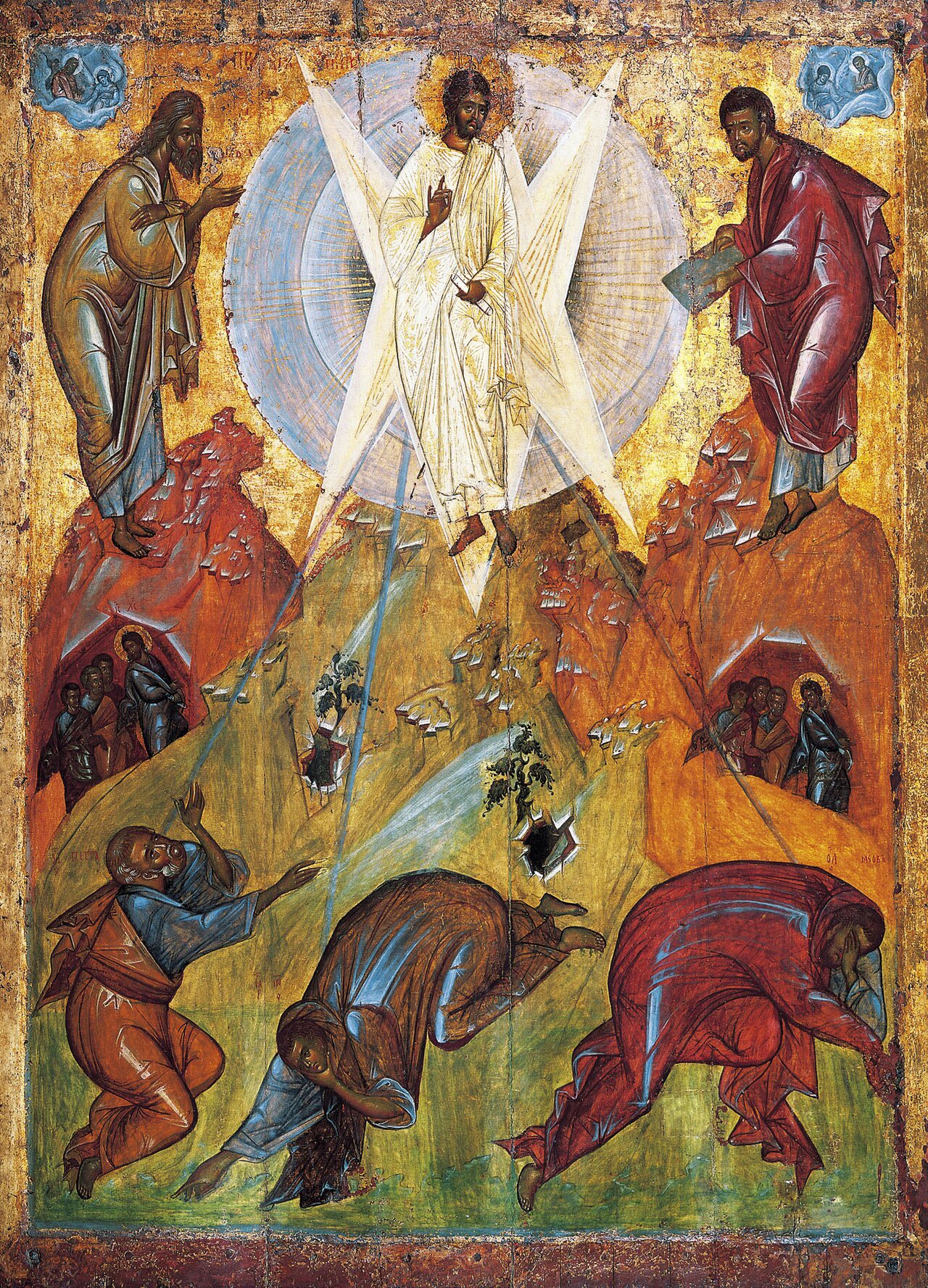
God had to keep taking old garments to heal me more. I did not let myself believe that a saint could freely come to me or cared about me enough to heal me, yet last month a saint came; Saint Ephraim of Nea Makri appeared and gave me peace and the freedom to heal. Old me wouldn’t allow a Saint to come, bound up by my rationale that Saint Ephraim is still in his grave or doesn’t love me enough. Just as the Pbarisees told Nicodemus, “Search the scriptures, no prophet has arisen out of Galilee,” I said, “Search the scriptures, saints can’t appear and heal us.” Yet Elijah and Moses appeared alongside Christ to Peter, James and John. They are free as Christ is free and made in His image. “Religion binds us”, as Father Zymaris always says, we get back into the bondage of our rules and rationality and will not allow ourselves to be healed through Christ and His saints. We go back to the hell of non-being that God brought us out of. Christ came to free us, and “If the Son sets you free, you will be free indeed.” Scripture speaks of Christ, “All of the law and prophets speak of me” yet like the disciples on the Road to Emmaus I refuse to see Christ or Saint Ephraim when they are walking beside me. The saints are the most free people on earth and in the Kingdom. The faithful in Acts were not bound as I was by the Old Testament, their scripture. They threw themselves under Saint Peter’s shadow and brought handkerchiefs from Saint Paul’s body for healing. And healed they were. Saint Ephraim offered me healing from my old man and I could only say thank you.
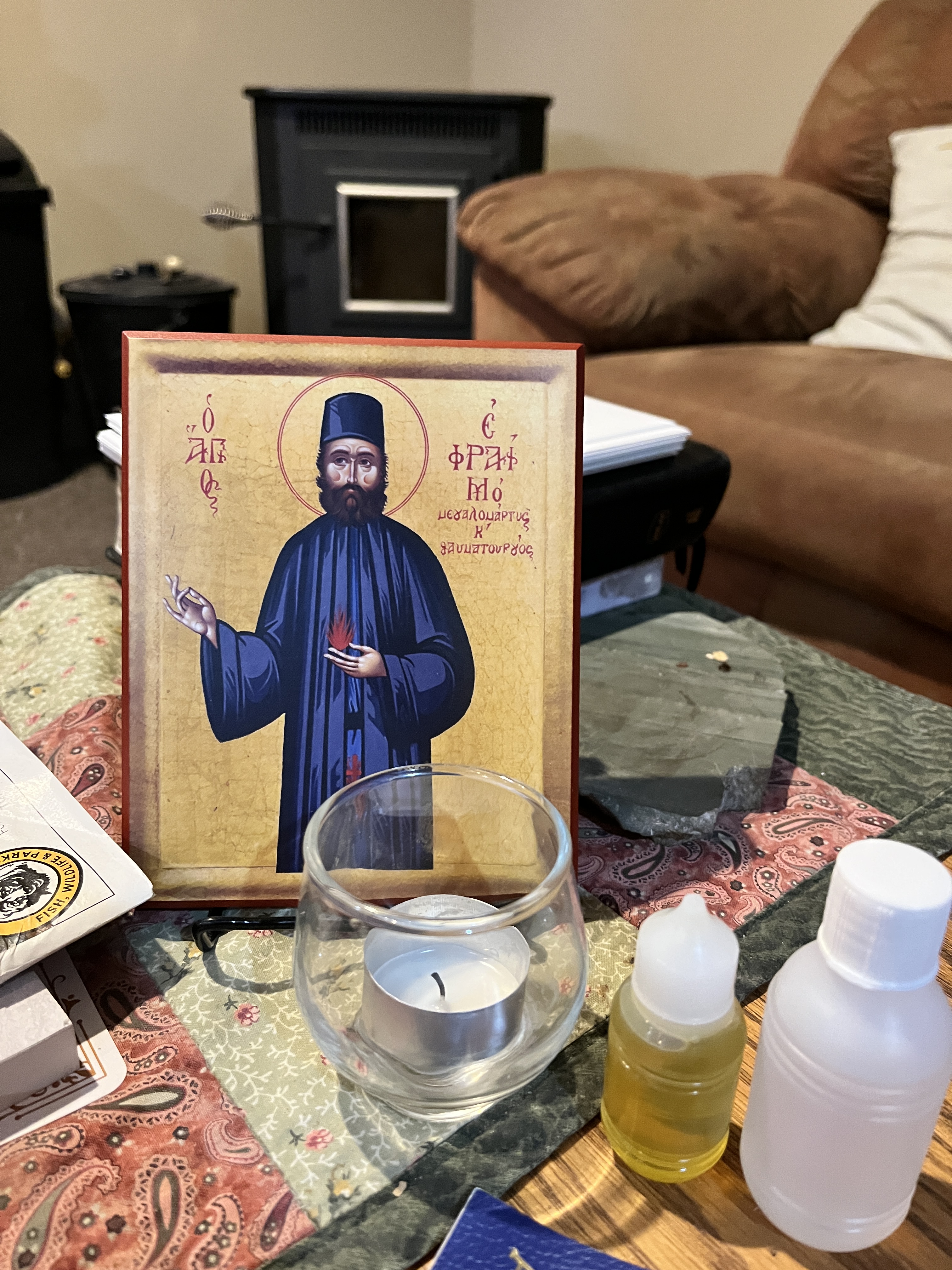
So what was making me sick? In my early twenties I took a curse on myself when one of my spiritual mentor told me, “If you don’t stop sinning you will ruin your ministry and your marriage.” I put on that garment and every time I would fall I would remind myself of that rule I bound myself with, “You can’t minister or get married because you sin.” When I got to seminary I donned a new old garment – expectations to be a perfect seminarian and follow all of the rules, “Orthodoxy o Thanatos!” (Orthodoxy or Death). Then I landed in the hospital, cried in pain for what felt like hours while Chris prayed and I thought “I can’t be a perfect seminarian and I can’t bear all these expectations of the new rule system so all I can do is die.” Then Saint Ephraim appeared to me, just loving me. Christ didn’t compel him to come, nor did Christ stop him. Saint Ephraim was free to get to know me and heal me.
The early church knew the freedom of miracles. They walked with Christ after He rose from the dead and saw thousands speak in tongues by the Holy Spirit. In the second century Saint Polycarp was tied to a stake with fire blazing around him. When the fire refused to touch his holy body a soldier stabbed him and the disciples of the disciples gathered his bones as miracle working relics. Over the next centuries these stories would be written down just like the stories of the first Christians in Acts and the story of the Mother of God in the Proto-Evangelium of James. The Holy Spirit inspired a generation of holy men to write the gospels. In later centuries the Holy Spirit inspired another generation of holy men to compile the gospels together as the New Testament; men who believed in the miracles the mother of God and walked with the heavenly saints. As long as I walk this earth I will be tempted to go back old garments of rules and miracle killers, back to religion that says these miracles can’t happen and saints can’t appear. But my only way to fully heal is to join the communion of the saints in their freedom.
- Von Balthasar, Hans Urs. Presence and Thought: An Essay on the Religious Philosophy of Gregory of Nyssa (A Communio Book) (p. 101). Ignatius Press. Kindle Edition. ↩︎
 Cycles of Newness
Leave a comment