
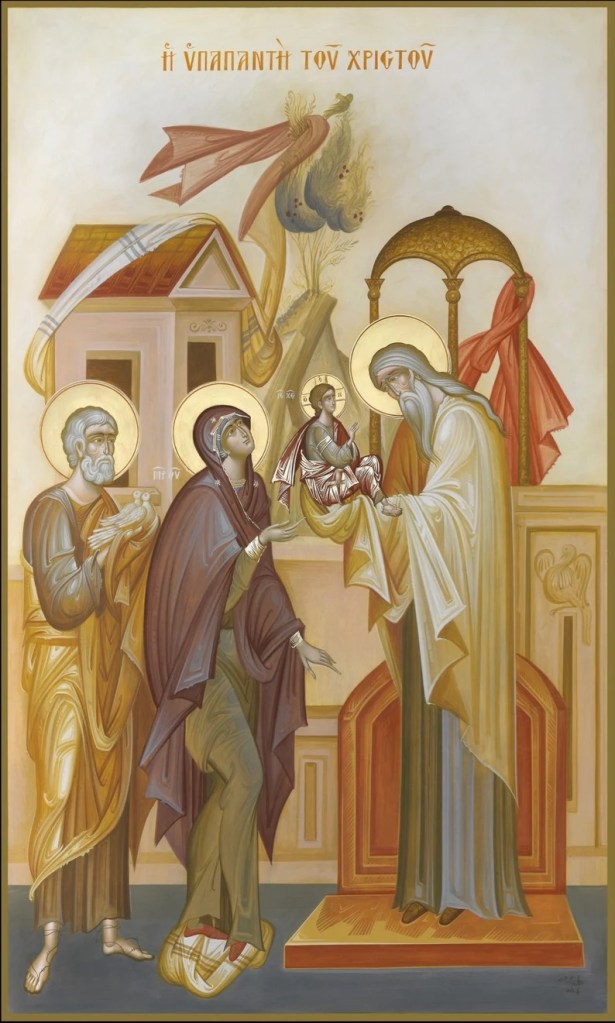
Today is the Feast for the Presentation of Our Lord in the Temple, when Saint Simeon held Christ in his arms and declared, “Lord, now let your servant depart in peace, according to your word; for my eyes have seen your salvation which you have prepared in the presence of all peoples, a light for revelation to the Gentiles, and for glory to your people Israel.” I used to read this as Simeon making a request to God that he might die peacefully now that he has seen the Messiah, but that’s not how the Greek reads. The Greek for “let” is a present tense verb ἀπολύεις, not an imperative and it is better rendered “now you are releasing your servant.” Saint Simeon holds Salvation Himself in his arms and this is the Lord releasing his servant to eternity in peace. “Blessed are the pure in heart, for they shall see God.” Saint Simeon’s pure heart beheld the babe in his arms as not just another child but the God-man. Beholding salvation is Simeon’s peace as he sees God as He is, the Prince of Peace. No longer does death hold power over Simeon, for he holds Life in his arms. God fulfills Simeon’s waiting with the sight of the Consolation of Israel.
A year earlier the Archangel Gabriel was sent to proclaim salvation to one like Simeon who prepared herself for God’s promise with a pure heart. When Mary saw the Archangel, He greeted her with, “Hail, highly favored one, the Lord is with you; blessed are you among women!” And the Theotokos replied “Behold the maidservant of the Lord! Let it be to me according to your word.” And the heavenly host sang “Peace on Earth and good will towards men.” Both Saint Simeon and the Theotokos faithfully offered themselves to God. To both God revealed Himself as flesh and their salvation.
Yesterday I was reading a comment by Bishop Zizioulas about the Anaphora, the part in the Divine Liturgy where the priest lifts up and offers the gifts of bread and wine brought by the faithful. He noted that in the early liturgies the Anaphora was the climax of the service, even more so than the consecration where the Holy Spirit descends on the gifts offered to make them Christ’s body and blood. Giving thanks, where we get the word Eucharist, was the main focus of early worship. The Jewish and Pagan cultures from which the early church emerged lived and died by their offerings to their deity. The god of a people gave them their crops, their health and protected their city from invasion. The people were commanded to worship that god with offerings of food and money to wherever the gods temple was. Offering thanks was life.
I don’t mean to suggest that the early Christians saw worship as transactional where bread and wine were offered for God’s favor. Christ revealed what true offering was; He offered Himself as the sacrifice that the world might live. The first Christians did the same, offering themselves for the peace of salvation. On his way to his martyrdom in Rome Saint Ignatius requested that the Roman church not interfere with his own offering, “This favor only I beg of you: suffer me to be a libation poured out to God, while there is still an altar ready for me. … pray leave me to be a meal for the beasts, for it is they who can provide my way to God. I am His wheat, ground fine by the lions’ teeth to be made purest bread for Christ.” Saint Polycarp too became an offering when soldiers tied him to the stake in a Roman arena and the Christians there saw him “in the centre of it, not like a human being in flames but like a loaf baking in the oven” giving thanks as he was lifted up in the Anaphora. The Christians of the early church grew up around altars first as pagans or Jews and now as the church; they knew what altars were for. The altar was the place where they offered up their gifts of bread and wine and beheld Christ in the chalice as the Theotokos beheld Him in her womb and Saint Simeon in his arms. “Lord, now you are releasing your servant in peace.”
Lord, let me be an offering to Thee.
 Cycles of Newness
Leave a comment