
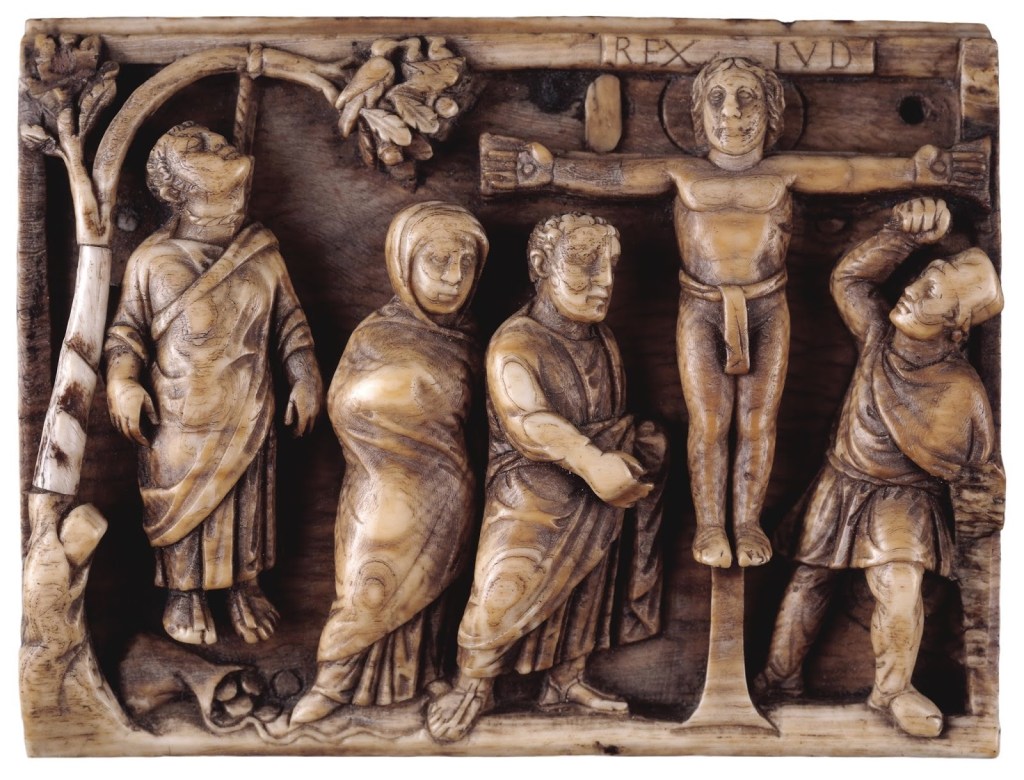
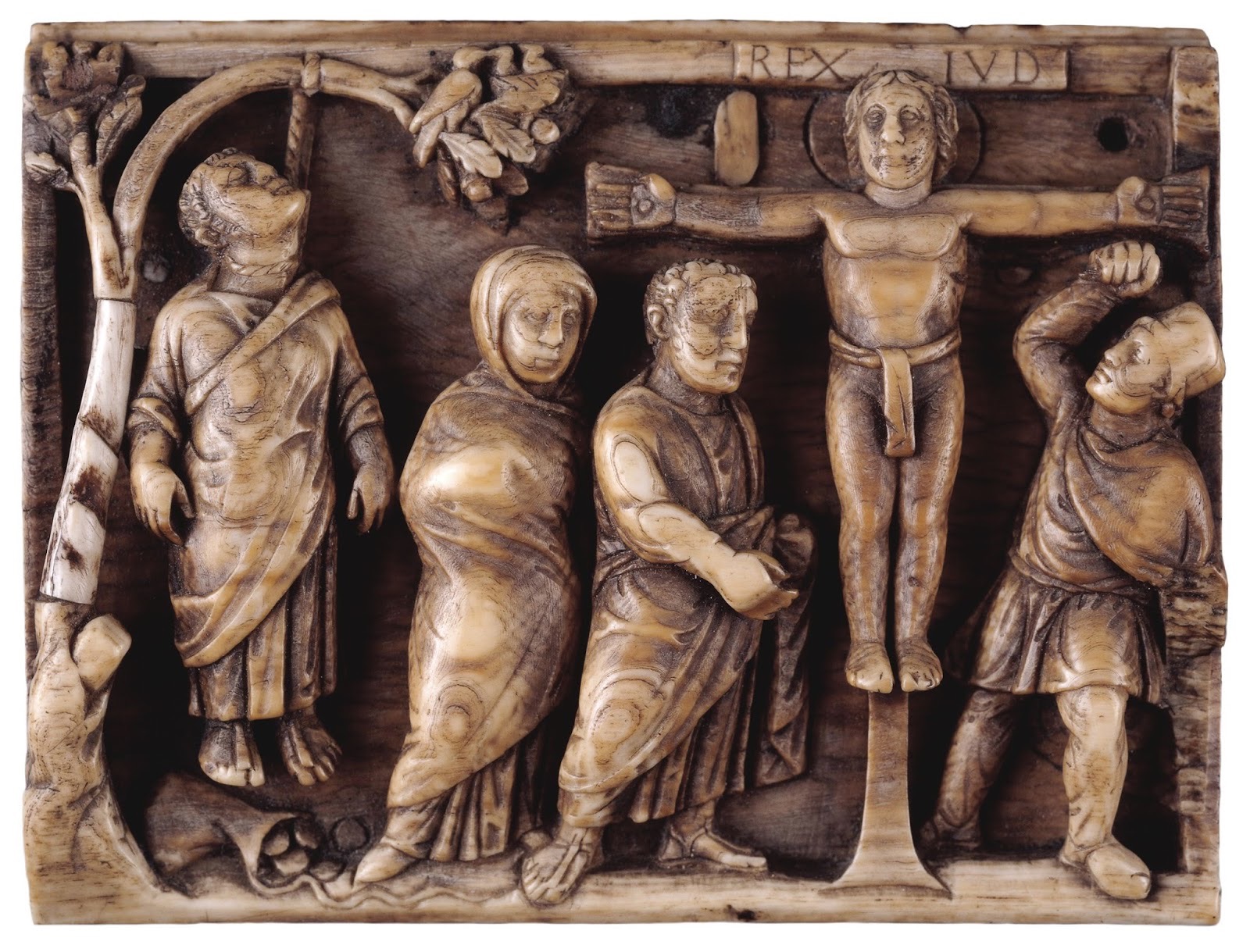
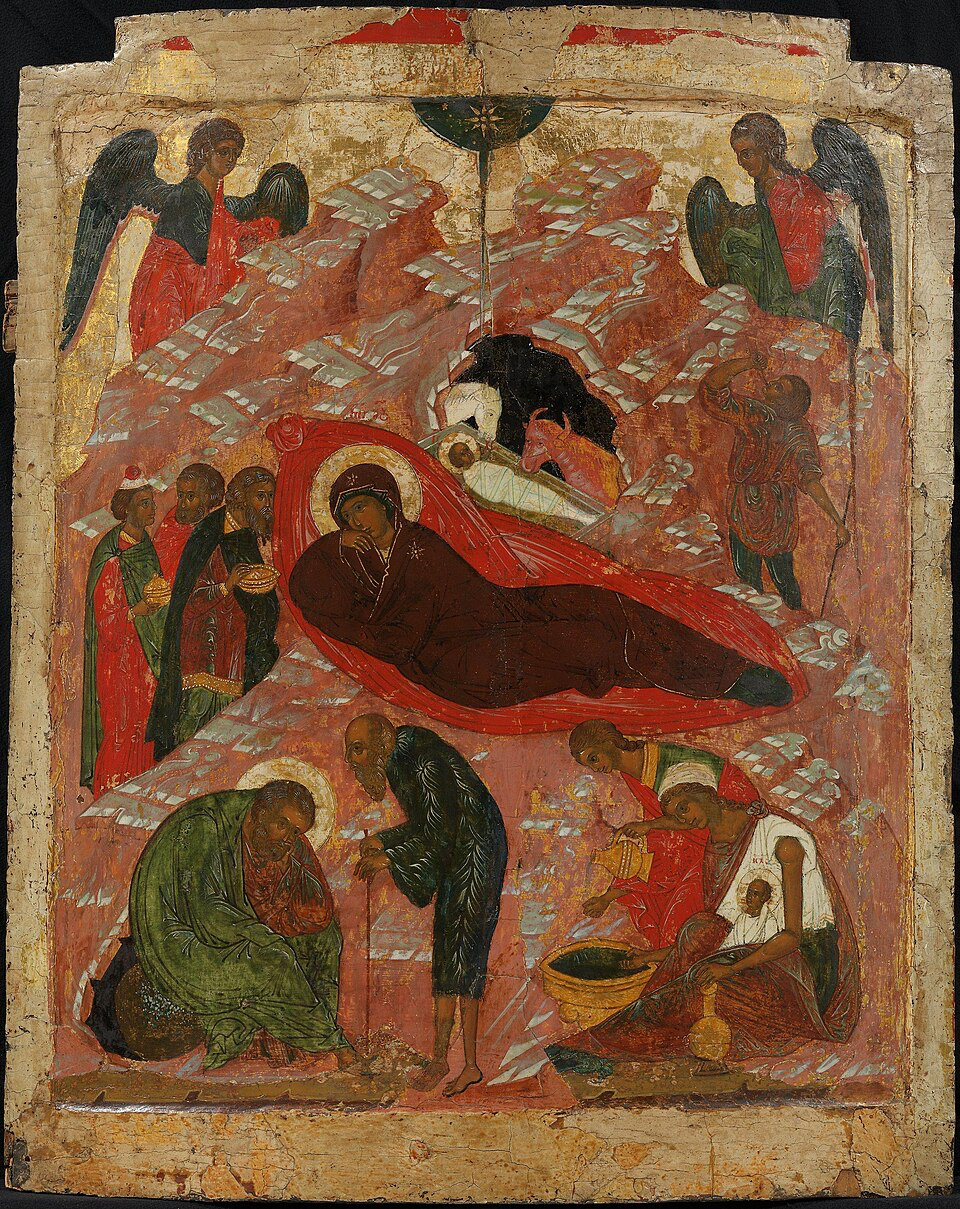
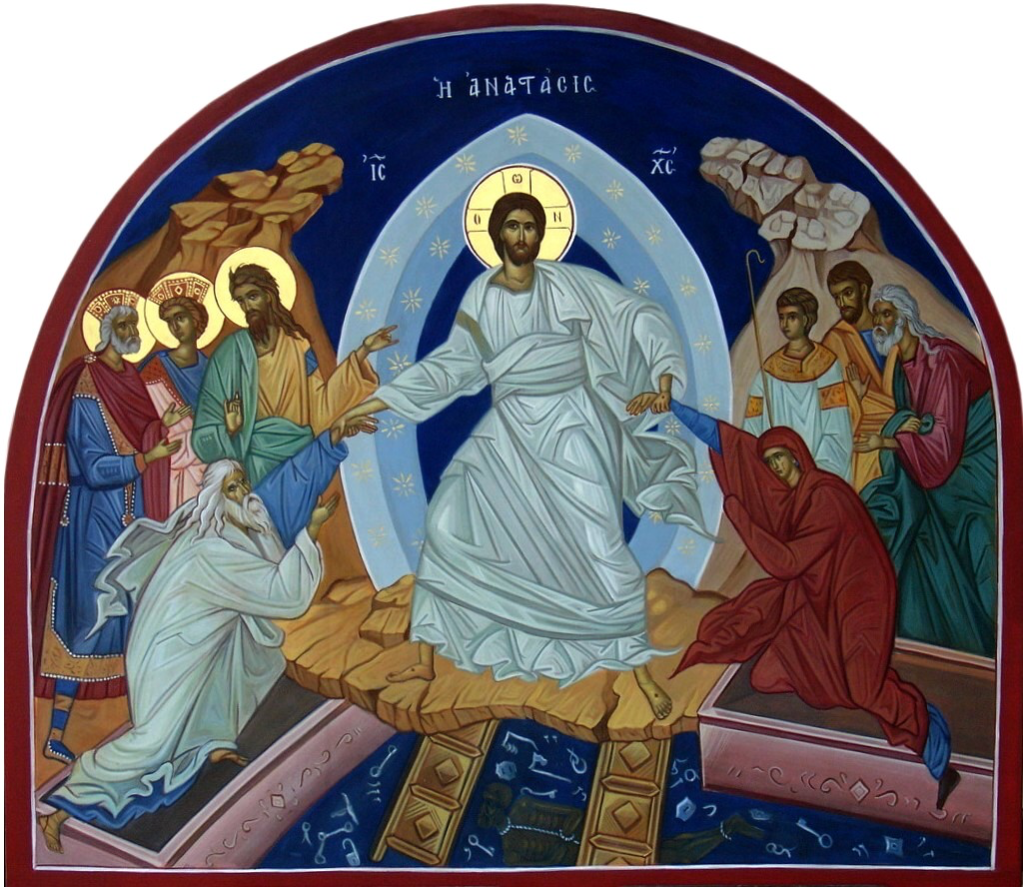
“In the West we love to separate things into little boxes of elements. One for gold, one for silver, another for bronze. But in the East the relationship of things took priority.” These were the words of the last lecture I had with my beloved professor and friend Bill McCurdy. In our modern Western framework we try to separate Christ into the historical events of his incarnation, crucifixion and resurrection and then pit each one against the other to decide which one is most important for our salvation. The early Christians did not separate the Incarnate One from the Crucified One who is the Resurrected One; the apostles knew Him as a single person and not as a series of historical events. The ancient icons of these feasts attest to this: the early Nativity icons depict the Son of God as the Incarnate one Crucified and Risen. The Christ child is wrapped in grave clothes in a pitch black cave that will become his tomb with the cross in His halo. The Theotokos is turned away pondering the sword that will pierce her Child and her heart (Luke 2:35). Joseph is tempted to despair about the virgin birth of God by a demonic figure while the midwives wash the crucified-and-resurrected one in a basin shaped like a baptismal font, prefiguring his baptism into death-unto-resurrection. The womb is also His tomb as the church has traditionally dated the Nativity from the First Pascha of March 25 (14 Nisan of that year according to the Jewish calendar) revealing Christ’s resurrection as the womb where He was revealed the firstborn of the death. (Col. 1:18) The Crucifixion itself is not a moment of despair, reflected in the early church’s celebration of the crucifixion and resurrection as a single Paschal liturgy. In the Maskell Ivory of the Crucifixion, Christ on the cross is not dead and lifeless but rather depicted in glory; His face looks up in victory rather than down to death with his arms outstretched to embrace creation rather than slumping in defeat. Juxtaposed with Him is Judas hanging from the tree clearly dead in despair. The one who gave up hope is hanging in his hopelessness while the One who is Hope offers Himself from the throne of His cross to give hope to all.
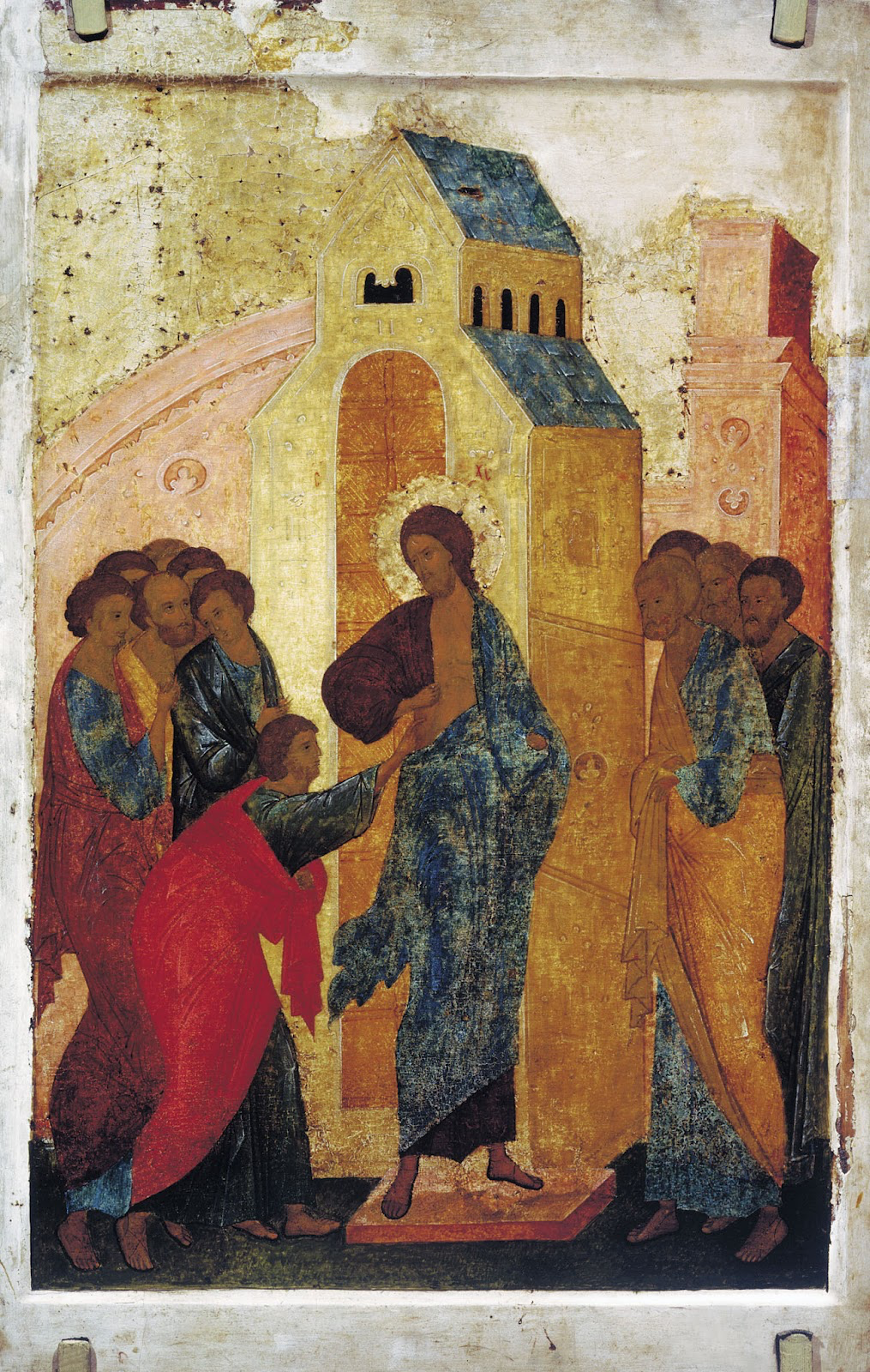
While the early Church worked to preserve the Christ they knew as a unified person, heresies arose that would try to separate Christ into sensible categories. Nestorius insisted that Christ’s divinity could not be born alongside His humanity therefore Mary could only be the mother of His human nature. Following the wording of Saint Cyril, the Third Ecumenical Council declared that Mary gave birth to a single person who is both God and man. Eutyches then overemphasized Cyril’s claim in such a way that the nature of God was so united to man that it overcame and gobbled up human nature. At Chalcedon the Ecumenical Council declared that Christ became man “in two natures” (ἐν δύο φύσεσιν) preserving both, rather than the non-Chalcedonian “out of two natures” (ἐκ δύο φύσεων) that mixed the divine and human into a single nature.1 Both council’s teachings are mirrored in the icons. The Maskell icon shows us the Christological balance in image: if I tore the image in two like Nestorius I would end up with Mary weeping over a dead man and a lonely God holding a banner of resurrectional victory. The single icon preserves the Paschal Mystery. As Father Zymaris says, “Cross and Resurrection are always together, one action: trampling upon death by death.”2 If I combined the crucifixion and resurrection like Eutyches the human part of Christ would be gobbled up – the nails would disappear and the wound in His side would vanish, overtaken by a divine body with no need to glorify flesh. Neither icon would preserve the theology of the apostles who personally knew Christ like Thomas when he pressed his fingers in Christ’s side and saw Him taken up in glory still bearing the marks of the nails.
What the Maskell icon does with image, Chalcedon does with words when it describes Christ as God and man united without division (ἀδιαιρέτως) and without confusion (ἀσυγχύτως).3 The single crucifixion-resurrection icon is Christ without division; the immortal God emptying Himself to the point of death on a cross (Phil. 2:6-8) that he might not be divided in any way from His creation. Zizioulas shows that it is the love of the Son of God that unites Him with His creation: “only love, in other words union ‘without division’ with the uncreated God, assures immortality, because everything created is destined to perish.”4 If the uncreated nature had not untied itself with the created nature at Christ’s birth then there would still be a gap between the two for death to inhabit as Saint John Chrysostom says, “Every ‘distance’ between God and man brings death.”5 Only an absolute absence of distance between Creator and creation reveals “love stronger than death.”(Song of Songs 8:6)
At the same time, both the Maskell icon and Christ’s union with man in the Chalcedon definition preserve distinction within the union; in the icon we can still see the nails and the triumph of God, and in the Chalcedonian Christ we can still distinguish humanity from divinity. If Christ united God with man in a way where we could not distinguish His humanity from His divinity, creation would be swallowed up by the Creator and love would no longer be free. The Son does not force a union upon His creation; God is free of all necessity and offers this same freedom to man made in His image. As Zizioulas says, “‘Without confusion’ … safeguards freedom, just as ‘without division’ safeguards love.”6 Only a union that preserves the otherness of creation prevents a collapse into a singularity and overcomes mortality.
The Son of the Father has always been in a divine relationship free of all necessity. He has never considered His sharing in the divine nature with the Father as something to retain or hoard; rather His kenotic act of descending into the likeness of men is the historical manifestation of the eternal self emptying shared between Him and His Father (Phil. 2:6-7). As He walked in the flesh He wept at Lazarus tomb (John 11:35), grieved in the Garden of Gethsemane (Matt. 26:36-46) and died as the lowest of men, refusing to destroy humanity or suppress man’s freedom to crucify Him. His earthly descent uniting with His creation in the Incarnation is the upright beam of the cross; His preservation of humanity to the point of crucifixion is its crossbeam. Upon this Cross built of freedom and love sits the crucified God who is the risen human being; to separate His Cross from His Resurrection or Incarnation is to sever man from God and divide Christ into little boxes of events. St. Peter attempted divide Christ from His Cross and the Resurrected One rebuked him sharply as “Satan” (Matt. 16:22-23). The Chalcedonian Christ “without division” and “without confusion” is cruciform. Zizioulas has at times been criticized for emphasizing the Resurrection over the Cross, but in light of Zizioulas other writings he makes clear that the Resurrection and the Cross are inseparable just like Chalcedon Christ and the Maskell Crucifixion.7 According to Zizioulas the Resurrection gives the Incarnation and the Cross their full ontological weight by “elevat[ing] the Cross to divine glory (Jn 13:31). Without the resurrection the Cross remains lying in the futility of death.”8 If Zizioulas were to dismiss the Cross, he would be repeating Peter’s error, but Zizioulas consistently makes clear the Crucifixion and Resurrection are a single Paschal mystery.
The Church walked with the Crucified-and-Resurrected-One on the road to Emmaus without a clue of who He was while He opened the scriptures to them. When He lifted up the bread in thanksgiving, they finally recognized Him. At the moment He was revealed He disappeared because in recognizing Him, His body – the Church – was finally present.9 The early church would continue to gather and offer up bread in thanksgiving as the center of the liturgy in the Anaphora.10 The Anaphora was where Christ as head became present when His body carried out His priestly ministry of offering creation back to God; the same offering He had made when He offered Himself on the Cross. When a convert came into the Church they were baptized into Christ’s offering on the Cross that they might share in His priestly vocation of thanksgiving. When much of the West followed Saint Anselm’s sacrifice-as-satisfaction model of salvation, it lost the beauty of offering up sacrifice to God simply out of thanksgiving.11 Zizioulas shows that the ancient liturgies all had a prayer of thanksgiving for creation but not all of them had a prayer for redemption by way of Christ’s sacrifice;12 Irenaeus echoes this liturgical witness by stating that God does not need sacrifice but is glorified in offering.13 As priest of creation the Church offers, “Thine own of thine own on behalf of all and for all.”14 Offering creation back to God in Anaphora is what the Cross looks like.
Last week I was using an AI to help me translate the Greek scroll King David was holding in an icon. The AI spoke in the first person so I asked the it if it considered itself a person; it continually clarified that it was not a person but a tool structured around imitating conversation. The AI was clear that it was distinct as a tool and in no way was it mixed with personhood but rightly ordered as an object. The crossbeam of the Cross set in place. Can AI be offered up to God in Anaphora? Zizioulas uses Colossians 1:20 to show that all of creation (τὰ πάντα) is saved by the cross, “through him to reconcile to himself all things, whether on earth or in heaven, making peace by the blood of his cross.”15 Salvation is not merely concerned with man satisfying God’s justice but the death and disintegration that threaten the entire cosmos. Thus when bread and wine are lifted up in Anaphora Christ is present and the elements are revealed to be what they truly are: His body and blood.16 The same is no less true for a tool like AI.
When man rightly takes his place as priest and offers creation like AI up to God in the cruciform of the Anaphora, AI is revealed to be what it truly is in the Kingdom, in the fullness of its telos. The monophysite and Nestorian extremes both tempt humanity’s relationship with a tool like AI. The monophysite extreme tempts humanity to use AI to rise above itself in transhumanism and proclaim itself God, confusing man with God and throwing humanity out as a result. The Nestorian extreme would separate the creation that AI is from God as merely a tool to be discarded, denying that it can be reconciled to God and therefore denying Christ’s work for all of creation on the Cross. When moralism seeps into the body of Christ the church sees herself surrounded by evils and feels her only course of action is turn-or-burn – burn the books, smash the wine kegs, delete the AI and tear down the icons. But another option is open: fashioning the sword of war into the plowshare of peace, “They shall beat their swords into plowshares, And their spears into pruning hooks.” (Isaiah 2:4) It is easier for the ego to consume the bread and AI than it is to offer them up to Christ in Anaphora. But it was precisely when He offered up the bread in thanksgiving that the disciples rightly recognized themselves as Christ’s body. AI held in the hands of the royal priesthood can be offered to God and revealed as Icon for humble service of the other. The Anaphora is Christ’s free act of kenosis, the offering made to God that Christ might be united to creation rather than grasping creation for ourselves, and at the same time preserving creation’s otherness without confusing the object with man made in God’s image.
The Anaphora of thanksgiving reveals the telos of all things as they are in the Kingdom of God: bread and wine are revealed to be Christ’s body and blood, the Son of God is revealed as the Savior of creation, and man is revealed to be the priest of creation. Man becomes truly who he is and Christ becomes “all in all” (1 Cor. 15:28) as Christ the microcosm of the universe offers Himself on the Cross. The man hung upon the Cross is the God who filled death with Himself as shown in the Maskell Crucifixion. Humanity can only offer creation rightly when the vertical axis and the horizontal axis of creation are maintained without division and confusion. Not offering AI to God would be akin to the lazy servant burying his single talent in the ground; his end was to be thrown into outer darkness (Matthew 25:14-30). The AI repeatedly defined itself as a tool, its distinction as object is the crossbeam of the Anaphora, half of the liturgical act. Humanity is called to finish that liturgical act. The center of the Trinity and all of creation is the Anaphora; laying our life down to offer up the other is what the Cross looks like. This paper began with a conversation with an AI clarifying itself as a tool, a partial Anaphora. To recognize it as the beginnings of the Cross is to recognize ourselves as the Body of Christ just like the disciples did at Emmaus, priests called to lift up creation to God that Christ might be recognized in our midst.
- Demetrios Bathrellos, The Byzantine Christ: Person, Nature, and Will in the Christology of Saint Maximus the Confessor(Oxford: Oxford University Press, 2004), 29-30. ↩︎
- Philip Zymaris, “Liturgics Lecture 10: Iconography II” (lecture, Holy Cross Greek Orthodox School of Theology, Brookline, MA, March 31, 2023). ↩︎
- John D. Zizioulas, Communion and Otherness: Further Studies in Personhood and the Church, ed. Paul McPartlan (London: T&T Clark, 2006), 260. ↩︎
- ibid. ↩︎
- John Chrysostom, Homilies on Ephesians 3 (PG 62, 26), as cited in Zizioulas, Communion and Otherness, 260. ↩︎
- Zizioulas, Communion and Otherness, 260. ↩︎
- Demetrios Bathrellos, “The Reception of Chalcedon: Georges Florovsky and John Zizioulas on the Existential Significance of Chalcedonian Christology,” Ortodoksia (2025): 148. In “The Reception of Chalcedon” Bathrellos claims that Zizioulas, “neglects sin and the cross” and emphasizes natural redemption. This claim separates sin and the cross from nature, whereas Zizioulas insists that sin and cross are cosmological and never separate from the resurrection. ↩︎
- John D. Zizioulas, Remembering the Future: An Eschatological Ontology (London: T&T Clark, 2024), 61-62. ↩︎
- Zymaris, “Liturgics Lecture 10.” ↩︎
- John D. Zizioulas, “Preserving God’s Creation: Three Lectures on Theology and Ecology, I,” King’s Theological Review12, no. 1 (Spring 1989): 4. ↩︎
- Anselm of Canterbury, Cur Deus Homo, in Anselm of Canterbury: The Major Works, ed. Brian Davies and G. R. Evans (Oxford: Oxford University Press, 1998). ↩︎
- Zizioulas, “Preserving God’s Creation,” 4. ↩︎
- Irenaeus of Lyons, Against Heresies IV.18.1 (ANF 1:485-86): “The oblation of the Church, which the Lord taught to be offered throughout the whole world, is accounted a pure sacrifice with God… not that He stands in need of a sacrifice from us, but that he who offers is himself glorified.” ↩︎
- The Divine Liturgy of Saint John Chrysostom, Anaphora. ↩︎
- Zizioulas, Remembering the Future, 61. ↩︎
- Alexander Schmemann, For the Life of the World: Sacraments and Orthodoxy, 2nd ed. (Crestwood, NY: St. Vladimir’s Seminary Press, 1973). Ch. 2 ↩︎
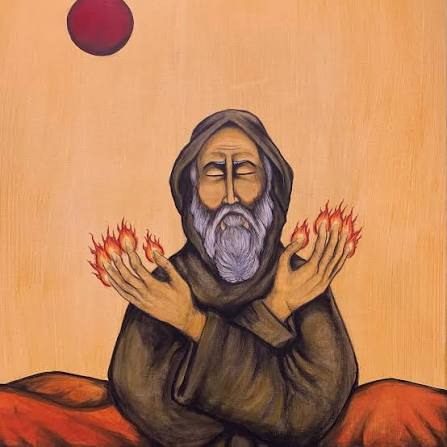
 Cycles of Newness
Leave a comment