
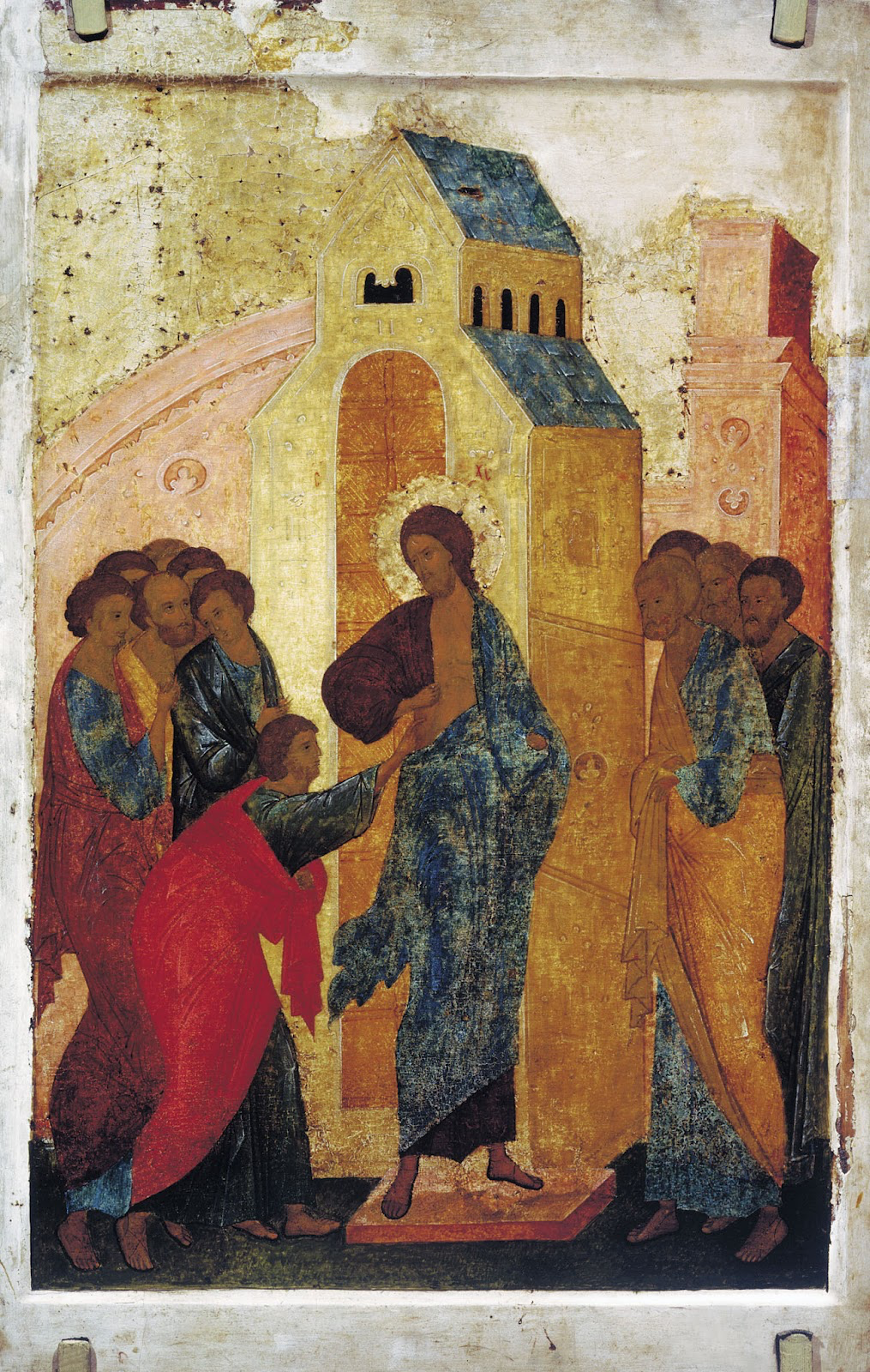
I have always been encouraged by Saint Thomas. He usually receives the title of “Doubting Thomas” for his refusal to believe the disciples’ account of meeting the Lord when Thomas was absent: “Unless I see in His hands the print of the nails, and I put my finger into the print of the nails, and put my hand into His side, I will not believe.” (John 20:25) Thomas was not willing to be satisfied with a secondhand story, and sometimes this places him in a category lower than the rest of the apostles for their faith. Christ’s later words — “Blessed are those who have not seen and yet believe” (John 20:29) — seem to imply that He was making an exception for Thomas, the only recorded exception in history, and that the rest of us are blessed precisely because we need not fall to Thomas’ level to believe in the Risen Lord.
But if we bring the account of Christ’s appearance to Thomas into full communion with the liturgical life of the Church, we find ourselves at the very center of what the Liturgy is: Christ bringing His people into the heart of the Kingdom, His very body.
The hymnographers of the Church paint a remarkably different picture of Thomas’ doubt. In the Pentecostarion, the service for the Sunday after Pascha dedicated to Saint Thomas we sing:
Thomas the Twin, the only one who dared, who by his faithful disbelief benefited us all, dissolves the gloomy ignorance for all the ends of the earth by his believing unbelief, and for himself clearly weaves a crown, crying out: You are the Lord, exalted above our Fathers and us, You are the blessed God.1
Thomas is described not as weak but as bold — ὁ μόνος τολμήσας, “the only one who dared.” His doubt is not condemned but celebrated as τῇ πιστῇ ἀπιστίᾳ — a “believing unbelief,” a “faithful disbelief” — that dissolves the ζοφώδη ἄγνοιαν, the gloomy ignorance, of all the ends of the earth. Hidden inside Thomas’ doubt is a crown and a confession: My Lord and My God.
How does Thomas come to see Christ so clearly as to make such a statement — the highest confession of Christ’s divinity found anywhere in the four Gospels?
Thomas is not serving himself when he declares his desire to see the hands and the side of the Risen Lord. He is being vulnerable, disclosing his whole desire without hiding anything — not even his doubt, even at the cost of criticism and anathema. He offers everything he has in his confession: I must place my hands in His side. Christ in turn offers Himself fully to Thomas, letting Thomas know Him as deeply as Thomas’ confession reaches. As Saint Maximus the Confessor makes clear, God knows us willfully and freely, and lets Himself be known willfully and freely — we are never compelled to know God.2 But to know Him and to be known by Him is precisely what salvation looks like. Thomas reaches his hand into Christ’s side and finds not a wound but life itself — the hymnography calls it the ζωοπάροχόν πλευράν, the life-giving side.3 To know Him thus, intimately as flesh and blood is eternal life. “This is eternal life,” Christ prays, “that they may know You, the only true God, and Jesus Christ whom You have sent.” (John 17:3)
Christ appears to Thomas on the Eighth Day. The Church began to gather on the first day of the week not only because it was the day of Christ’s Resurrection, but because it is the day beyond the seven of creation — the day of Eternity itself.4 The Sabbath is the last day of the old creation; the day after the Sabbath is the day of the new Heaven and the new Earth. When Christ comes through the shut doors, Eternity enters the room. The Kingdom of God is fully in their midst, for where Christ’s body is gathered, there is Christ; and where Christ is, there is the Kingdom. “The Kingdom of Heaven is at hand.” (Matthew 3:2) This is why the early Church gathered on Sunday — not merely to commemorate a past event but because they understood themselves to be entering into Eternity in a literal sense. In the icon of Saint Thomas placing his hand in Christ’s side, the disciples are gathered around Christ in the shape of the synthronon — the semicircular throne from which the bishop would preside over the Eucharistic assembly in the early Church — the same arrangement in which the elders gather around the bishop who leads the assembly even today, and the same arrangement in the Kingdom where the twenty-four elders gather around the Lamb in Saint John’s Revelation. Every time His body gathers and offers their thanksgiving — their Eucharist — they place their hand into the Kingdom.
Thomas could have been satisfied with the disciples’ account. He could have opened the Scriptures to the testimony of his fellow apostles and said, “It is written, therefore I believe.” But instead he gives what the Church calls a blessed rejection of the mere retelling — τῇ ἀπίστῳ τε πίστει, a “disbelieving trust” — demanding to touch the mystery of his salvation. He had read the prophets and the Law, yet he was not satisfied with history alone. And Christ did not say to him, “You have the Scriptures and the witness of your fellow disciples — be content.” He said: reach here your hand. (John 20:27) Put it into the Kingdom.
Do we not do this every time we celebrate the Divine Liturgy? Christ offers His very presence — His body, His blood, His side — and we enter into the Kingdom of God and the Last Days. The Liturgy is not a retelling of what happened to Thomas and the disciples. It is the same Eighth Day. The same shut doors. The same Lord entering. And the same invitation: reach here your hand. By his willingness to know and be known by God, Thomas gave us the greatest confession of faith in all of Scripture — Ό κύριος μου καί ό θεός μου. My Lord and My God (John 20:28)
The Second Person of the Trinity, our Christ is on the right of the Heavenly Father in the Holy of Holies. Therefore, my dear, do not think that when we enter the church, we enter and leave, and then we enter again. No! We climb and enter the Holy of Holies, to the heavens. When we open the curtain and Christ comes out, as the Holy Cup, we open the gate of Heaven… and we enter, the sinners. As we enter the church, during the Divine Liturgy, we climb to the New Jerusalem from above. Do you understand what a great thing this is? What our souls live… And we will sit at the right of the Father!
~ Elder Aimilianos of Simonopetra5
Do not be content with stories, with words, with rules that say “you must believe because religion demands it.” Saint Maximus tells us that unwilling, unfree belief — belief under compulsion — is the faith of the demons.6 God will not force Himself upon us. To those He does not know He says, “Away from Me, I never knew you.” (Matthew 7:23) But to those whom He knows, and who know Him, He says, “Well done, good and faithful servant.” (Matthew 25:21) Christ is the Kingdom. His body is His Church. We are His body. We enter into the Kingdom, place our hand into His side, and cry with Thomas and with the whole assembly of Heaven: My Lord and My God. Reach here your hand.
- From the 7th Ode of Matins for Saint Thomas Sunday, “Ὁ μόνος τολμήσας, τῇ ἀπίστῳ τε πίστει, εὐεργετήσας ἡμᾶς, Θωμᾶς ὁ Δίδυμος, λύει μὲν τὴν ζοφώδη ἄγνοιαν τοῖς πᾶσι πέρασι, τῇ πιστῇ ἀπιστίᾳ, ἑαυτῷ δὲ τὸν στέφανον πλέκει σαφῶς, λέγων· Σὺ εἶ Κύριος, ὁ ὑπερυψούμενος τῶν Πατέρων καὶ ἡμῶν, Θεὸς εὐλογητὸς εἶ.” ↩︎
- Maximus the Confessor, Mystagogy, ch. 1; cf. also Ambigua 7 on the distinction between natural and gnomic will — the gnomic will as the mode of free, personal movement toward God. ↩︎
- From the sticheron of Thomas Sunday, Pentecostarion: Τῇ φιλοπράγμονι δεξιᾷ, τὴν ζωοπάροχόν σου πλευράν, ὁ Θωμᾶς ἐξηρεύνησε — “With his truth-seeking right hand, Thomas searched out Your life-giving side.” ↩︎
- On Sunday as the Eighth Day see: Justin Martyr, First Apology 67; Basil the Great, On the Holy Spirit 27; and for the eschatological dimension, John Zizioulas, The Eucharist and the Kingdom of God (2022), and Alexander Schmemann, For the Life of the World (1963), ch. 1. ↩︎
- Elder Aimilianos of Simonos Petra, “Christian Mystery,” in Liturgy and Pastoral Care. Published at otelders.org. Elder Aimilianos (1934–2019) was hegumen of the Monastery of Simonos Petra on Mount Athos, widely regarded as one of the most significant monastic voices of the twentieth century. His collected homilies and spiritual writings have been published in English by Indiktos Press and Alexander Press. https://youtu.be/pxiEEZ2uT6s?si=vLb7mu8Xgyxtf46e ↩︎
- Maximus the Confessor, Disputation with Pyrrhus; the distinction between willing/natural faith and the compelled assent that even demons give (James 2:19). ↩︎
 Cycles of Newness
Leave a comment