
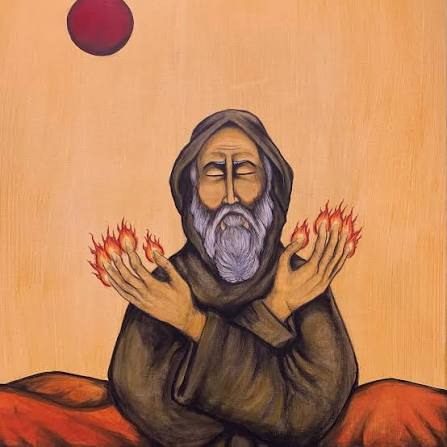
If you will, you shall become all flame.’
~ Abba Lot
Over these past couple months I have been talking with a dear friend about all things early church, from the Jewish scriptures of the apostles to “How are things so different now?” I am not going to rehash those conversations but rather address the last question she asked, “How do I know what God wants me to do?” We discussed various options – being a good person, accepting the canned answers of “the Bible says”, as well as questioning every assumption about God and faith we received growing up.
Personally I got tired of the sermons from my youth, whether it was what Billy Graham said what Paul said or what Mars Hill guy said what Paul said. I was tired of the spoken word and the written word. Show me. Show me the Kingdom of God. Shut up and let me enter into Christ’s side.
Modern man preaches while the first Christians stood in the Kingdom every time they gathered. They ate Christ. They knew Him like Adam knew Eve. (Scandal!) They were burned, tortured, sawn in two, beheaded, mocked, put to the stake. Mothers cut their breast to baptize their children before they were executed. Some wrote it down and others like the Theotokos never put a word to paper but instead gave birth to the Word Himself, the Logos. And they argued, fought, and struggled with each other. And they came back together for communion, to live as life for their brother, for the Eucharist was beyond their opinions and disagreements. Pagan and Jew forsook all and were martyred for Christ side by side.
The martyrs had no clear cut answer to “how do we get saved?” They had no perfect Bible verses they could quote or a sinner’s prayer. They only knew Christ and Him crucified. They supped with Him every Sunday when they gathered. Saint Potamiaena appeared to fellow soon to be martyrs after her own martyrdom, encouraging them to grasp their heavenly crowns. In the second century the Bishop of Antioch gave instructions to the Roman church to not interfere in his own martyrdom,
He who died for us is all that I seek; He who rose again for us is my whole desire. The pangs of birth are upon me; have patience with me, my brothers, and do not shut me out from life, do not wish me to be stillborn. Here is one who only longs to be God’s; do not make a present of him to the world again, or delude him with the things of earth. Suffer me to attain to light, light pure and undefiled; for only when I am come thither shall I be truly a human being.1
Then Christianity was legalized and the Christian hermits fled into the Egyptian desert to find their salvation, to be divinized with Christ. Abba Joseph of the desert fathers had perfected his prayers, his fasting and his thoughts. He did not know what more to do so he sought out Abba Lot:
Abba Joseph came to Abba Lot and said to him: ‘Father, according to my strength I keep a moderate rule of prayer and fasting, quiet and meditation, and as far as I can I control my imagination; what more must I do?’ And the old man rose and held his hands towards the sky so that his fingers became like flames of fire and he said: If you will, you shall become all flame.’2
Centuries later Luther, Calvin and others would have an argument with the Latin church. The food of the martyrs, Christ’s body and blood was traded for grape juice and Sola Scriptura. People were put to death for heresy. Happened a lot. Since the Eucharist was now a cracker, the faithful no longer shared the heavenly banquet with the heavenly host and the saints became examples of being nice people.
And we could call that the end. “We tried.” We could go back into our holes and stop asking questions. Be a good boy, (or girl). Say our moderate rule of prayer, give our canned answers and win our dumb arguments.
Or we can become all flame.
- Andrew Louth; Louth, Andrew; Staniforth, Maxwell. Early Christian Writings: The Apostolic Fathers (Classics) (p. 87). Penguin Books Ltd. Kindle Edition. ↩︎
- Ward SLG, Benedicta; Anthony [Bloom] of Sourzah. The Sayings of the Desert Fathers: The Alphabetic Collection (Cistercian Studies Series Book 59) (p. 22). Liturgical Press. Kindle Edition. ↩︎
 Cycles of Newness
Leave a comment