
“If we say we have koinonia with Him and walk in the darkness we lie and do not practice the truth.” (1 John 6)
Last week I wrote about my talk with Matt and Chu and our innate desire for communion as our true salvation. That’s a bold claim. What then is communion and why is it the heart of salvation?
Communion comes from the Greek word koinonia and has been translated in scripture as both “communion” and “fellowship,” giving completely different meanings to this common word of the ancient world. “Fellowship” implies spending time with another or simply being in the same club, a fellowship of fellow paper writers at a university. “Communion” carries an ontological meaning, persons who share communion are affected at the level of their being: if one person struggles, I struggle with them in reality, not just in my thought or sentiments. If they rejoice, I too rejoice in my being. Communion is more than spending time together, it is a way of being. Our source of understanding what the fullness of communion looks like is the Trinity, “I am in the Father and the Father is in Me.”
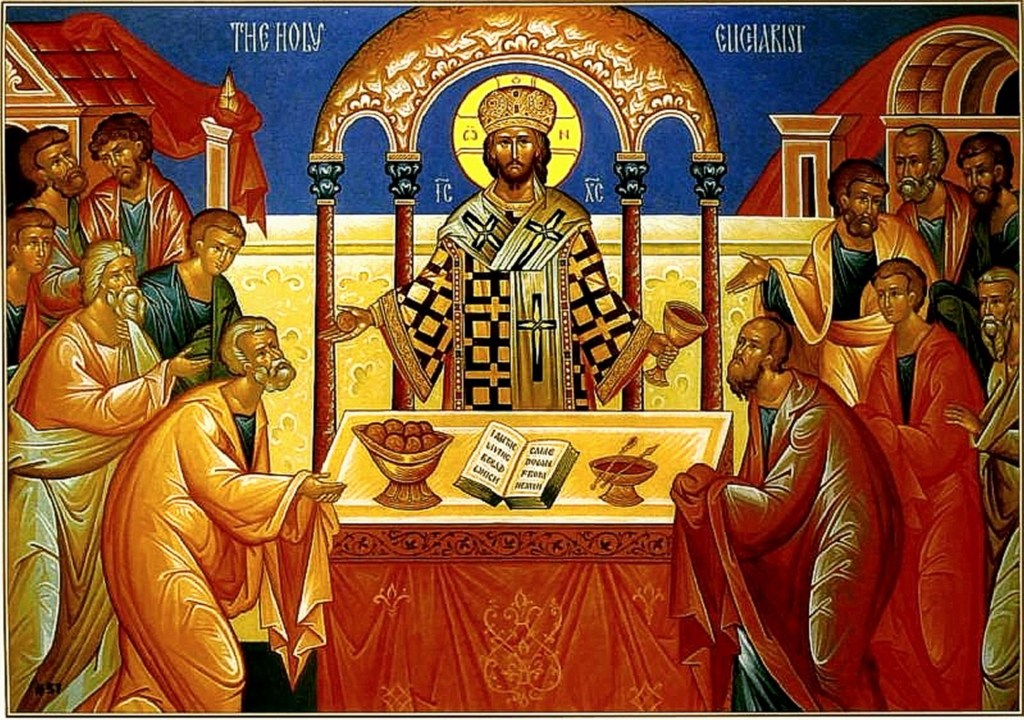
What is it to have communion with God? When Orthodox Christians celebrate the Eucharist we participate in Christ’s very being who is “the Way, the Truth and the Life,” and “are made partakers of the Divine Nature”. Why do we need to participate with God at the level of His nature and not simply be forgiven of our moral wrongs? Our guilty actions are strikes against us on a moral and legal level but the root of the problem is deeper. As Orthodox we don’t understand original sin as us inheriting Adam’s guilt but rather inheriting the shame of a world broken at the level of its essence and identity. When Adam ate of the tree, he was severed at the level of his being from communion with God Who is Life and Death entered into the world. Christ did not become man just to fix a moral problem but unite man with Life Himself in communion. God did not come to make bad men good but to make dead men live.
Communion is our salvation as every bit and level of us participated in Him and is healed. Our identity, essence, moral failings, regrets, thoughts, feelings and even our personhood is united to him while none is lost or diminished. Death has lost its sting. In the ancient world the sacred places and rituals were never known as ‘mere representational symbols’ but true participation in the spiritual world and the Christian sacrament of the Eucharist was not an exception. I have been learning in my liturgics class that the ancient Christians would all gather together outside of a church with the clergy and then enter in together as the Body stepping into the Kingdom of Heaven, not as a re-enactment of Christ’s life, that imagery would be added later. They were literally standing in Christ’s Kingdom receiving His Flesh and Blood from His own hand through the episcopos (bishop) who was the symbol of Christ handing it to them. The Greek word symbolos meant “to put two things together” where both things were understood to be present, not “one thing that stands in place of the other” a meaning that would come with the Enlightenment. The pagan idol, the Temple in Jerusalem and the Eucharist were all symbols in the ancient sense, the god was in the idol, Jehovah rested in the temple and Christ was present in the Eucharist. Men truly died from taking Christ’s body and blood unworthily as Paul witnessed in 1 Corinth 11.
So why do we long for communion as our true salvation? Why not just be forgiven our moral wrongs and let the other “live and let live.” The Image of God surrounds us in every face and reminds us of our longing for communion with Him, our own identity restored. As Saint Silouan said, “My brother is my life;” every person we see is a unique wonder that longs to be restored to be fully themselves, persons in communion. “May they be one as we are one.” We cannot be persons without communion, one person screaming “I am” into the void is no person at all. We long for the other, for Christ, for Adam, for Eve. Christ longs for us and we know this, and only communion of all that is good with all that is good will satisfy the Divine Longing.
 Cycles of Newness
Leave a comment