
I wrote this for a friend of mine who asked about my walk into Orthodoxy with Bill at his funeral. May his memory be eternal.
The last conversation I had with Bill McCurdy was at bible study on September 21, 2021. He shared two thoughts that completely encompass his faith – to stand for the Truth no matter how painful and to share the Gospel. Bill related his favorite saint with everyone, Saint Maximos the Confessor, who “had his arm cut off and his tongue cut out because of his conviction of the Truth.” Bill had brought Saint Maximos’ “On the Cosmic Mystery of Jesus Christ” to Bible study as his ‘fig leaf’ as he called it. Bill was a true disciple of Saint Maximos’ example, always speaking the truth according to his conscience. A little later into our discussion I made a poor attempt to explain our unique personhood in terms of the blessings that are the Saints of our Church. Bill managed to put my thoughts together in his typical eloquent fashion – “In any object like gold or silver we try to get rid of the unique impurities to make them more valuable, we refine gold to make it pure gold so that it has more value. But persons are valuable because of their unique, unrepeatableness. I am valuable as a person because I am Bill and I cannot be repeated.” To some in Orthodoxy the salvation of the person is the essence of the Gospel, as Bishop John of Pergamon writes, “The eternal survival of the person as a unique, unrepeatable and free hypostasis (υπόστασις), as loving and being loved, constitutes the quintessence of salvation, the bringing of the Gospel to man.” (Being as Communion, p. 49) With Truth and Gospel, I will make a weak attempt to describe my walk with Bill into the fullness of faith found in the Orthodox Church.
A Beginning
Be at peace with your own soul; then heaven and earth will be at peace with you. Enter eagerly into the treasure house that is within you, and so you will see the things that are in heaven; for there is but one single entry to them both. The ladder that leads to the kingdom is hidden within your own soul. Flee from sin, dive into yourself, and in your soul you will discover the stairs by which to ascend.
Saint Isaac the Syrian, Homily Two
I must first confess that I did not become Orthodox because of sweet tunes, great Theology or a good sales pitch. I’m simply too weak to be anywhere else. I can’t even say I “choose” Orthodoxy, but instead showed up at the Assumption and never left. The previous year I had found “rock bottom” – a place where all my thoughts were critical and my body couldn’t walk to class without a cane. I was fractured into a million different parts; mind, body and spirit alienated from one another. Bits and pieces of me were shutting down, that’s just how it was.
A couple years earlier in 2013 I had the opportunity to have a crisis of faith when I was studying in Germany. That was the first time in my life that I did not have a group of friends that shared the same religious upbringing (American Evangelical Christian) to retreat to when life approached me with challenges. West Germany is predominantly Catholic so I attended Mass on Sundays in order to worship. Liturgical worship is centered around Communion, or as the Catholics would call it “The Eucharist.” That summer I attended a Mass in Berlin with a Catholic friend of mine, Thomas. When we had sat down in our pews he scanned the sanctuary and pointed out the Tabernacle where the Body and Blood of Christ are reserved. I was surprised that he would look for God in physical space; I had never encountered someone who believed that God could be present in a specific place outside of human hearts (itself a place of metaphor.)
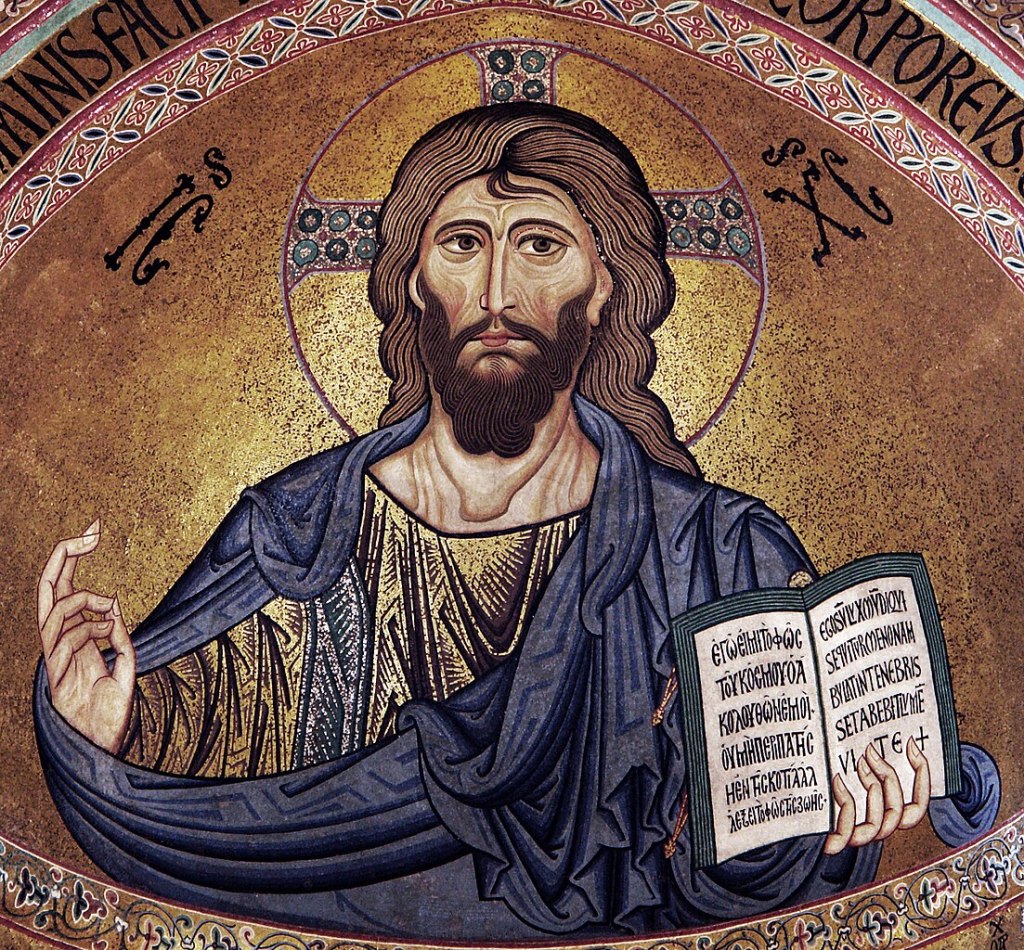
Between semesters I traveled to Geneva, Switzerland to get some adventuring in. Geneva as home of the Reformation has a wide variety of cultures and creeds. On Sunday after peering into John Calvin’s church like a tourist I happened upon a small Russian Orthodox church with golden onion domes. As I approached the doors a few beggars held their hands out for alms (no kidding.) I squeezed between a standing sea of faithful believers in the middle of a three hour service. A random column would split the sea of people; turning left or right at one would open to an alcove of candles in front of an icon of a Saint or the Blessed Virgin Mary. I could hear some deep singing that sounded repentant yet commanding, leading the faithful from the front of the church. An aged priest with white hair crept out from behind a wooden screen separating the congregation and the altar. As he passed through the altar doors he swung a censer which parted the Red Sea of people who responded with crossing and bowing. He circumvented the sea by traveling from icon to icon along the perimeter, stopping at each one to offer the censer and then turn to cense the people as well. When he censed the sea it would bow back tracing crosses on the abdomen with curled fingers. The sea was always facing the censer, always praying. Finally he returned to the altar doors; on his left he censed the Icon of Theotokos, the Holy Virgin, and on his right the Pantocrator, Christ the just judge. I saw something I could not explain, but I took no further interest at the time, instead filing it away as “that’s how those people worship.”
At the University in Paderborn I took a Catholic Theology class on “Love in the Trinity” Dr. Klaus asked hard questions about love, will and God. “How can God love us if He doesn’t allow us to reject him? Love must be free. Why would Christ ask us to love our enemies? What about human suffering? Why does God allow the innocent to suffer and perish?” This last question stuck with me, I could not answer for the suffering of others, let alone my own struggles. “Why?” I remember a younger version of me asking a pastor that question after the tragedy of a church scandal, “Why would God let this happen?” Neither of us had a response. I digress. The question was compounded after a few talks with locals about the German struggle with the shame of the Holocaust, even today in the current generation. The sins of the fathers passed down as shame. One of my German friends related how it had only been a couple years since anyone had the courage to fly a German flag at a football game (soccer for us Americans.) I didn’t have the courage to dive deep so far from my familiar homestead, so when I got back to Pocatello I took a class on the Holocaust at ISU. New questions about shame and forgiveness arose from books like The Sunflower and Night. Exodus from light, to cloud, to darkness had begun. (St. Gregory of Nyssa)
The Cloud of Unknowing
God is known both through knowing and through unknowing . . . He is nothing of what is, and therefore cannot be known through anything that is; and yet He is all in all. He is nothing in anything: and yet He is known by all in all, at the same time as He is not known by anything in anything.
St. Dionysius the Areopagite, Divine Names, VII, 3 (PG 3,872)
As I was leaving College Market on a spring day in 2016 I happened to run into a philosopher sporting a cowboy hat, carrying some yellow paper and a book. Bill introduced himself as a friend of Phillip Homan, who I had befriended at the Assumption during Lent that year. He was delightfully surprised to run into me, he had heard from Phil that I had been attending the Lenten services and was interested in Orthodoxy. He went on to relate his own struggle within the Catholic Church, specifically the church’s hostility towards traditional Catholics and the banning of a local priest from holding the Traditional Latin Mass. The next Sunday Bill showed up for the Divine Liturgy at the Assumption.
For the next year Bill and I attended Liturgy and took a class on Orthodoxy offered by the priests serving at the Assumption, Father Constantine and Father Seraphim. Finally on January 6th of 2017 Bill and I were chrismated at the Assumption on the Feast of Epiphany. Epiphany, also known as the Festival of Lights, celebrates when Christ was baptized by St. John in the Jordan river. Epiphany means “revelation,” where the Trinity was revealed by descent of the dove and the words of the Father, “This is my Son in whom I am well pleased.” (Matthew 3:17) At our Chrismation Bill and I were revealed to be what we truly are – persons made in God’s Divine Image. I took the Eucharist for the first time, Christ’s Body and Blood present in the humble elements of bread and wine. (John 6:53) Previously I had only known communion as a place of memory – a mental reflection on the historical act of the Crucifixion in A.D. 33 and an accompanying memory of my personal acceptance of that fact. In the Eucharist I encountered Christ, “The lamb slain before the foundation of the world” (Revelation 13:8) who is “everywhere present and filling all things.” (Eph 1:23) Orthodoxy understands communion as a sacrament. Sacrament traces its origins to the Greek word mysterion (where we get the English word mystery) “A mystery is . . . something that is revealed for our understanding but which we never understand exhaustively because it leads into the depth or the darkness of God.” (Ware, The Orthodox Way pg 15) Sacraments like baptism and communion are known by the celebrant, the person taking part, but are simultaneously unknown, held within the Divine Mystery. In this way they share something in common with the person celebrating. Our personhood is never fully explored but remains an eternal mystery – as mysteries then we partake of mystery. Or as the Liturgy says, “Thine own of thine own do we offer unto Thee on behalf of all and for all.”
On Icons and Symbols
I would bump into Bill at Mocha once in a while. One time we got to talking about indexes and icons. Bill explained his distaste for a certain modern philosopher who posited that “symbols can only be merely symbolic. If I see a symbol, that symbol can function as an index and point to the thing it symbolizes, but the thing the symbol points to is absent in the symbol itself. If I see an American flag, it can remind me of America but I can say for certain that America is NOT in that flag. The symbol and the thing it symbolizes are mutually exclusive.” This argument is opposed to the ancient understanding of symbols where the presence of the thing is indeed in the symbol itself. Bill used a Newspaper stand as a proof, “Consider a Newspaper stand. How do you know if the Newspaper stand contains newspapers? I look in the window and what do I see? A newspaper, and that tells me that the newspaper stand isn’t empty. So the newspaper is acting as an index and a symbol. But I can also take the newspaper out, it itself is the very presence of the thing it is symbolizing. It is simultaneously functioning as an index and it is the presence of the thing it points to.” In the Orthodox tradition, which again is a product of the ancient world in which it lived, holy relics and icons work like the newspaper; they remind us of a saint or holy event and simultaneously are a part of that which they point to. A piece of wood from the Holy Cross reminds us of the cross from which it came on which we find the Crucified God, but it is also life-giving and many miracles have come from the cross itself. In the same way an icon is holy precisely because the person within the icon is united to God. When I see an icon of Saint Paul, I can say ‘that is St. Paul’ and I don’t mean it in a merely symbolic way.
Breakfast
Bill and I had conversations about this journey of Faith over pork chops at Oliver’s. We both struggled with the damning God of fire and brimstone that is hammered hard in fundamentalist sermons like “Sinners in the hands of an Angry God.” A crisis of faith hides a unique gift – facing one’s self righteous judgement of the salvation of other people. Bill once confided in me that he prayed a lot for his father whom he loved and looked up to very much. He asked me in all seriousness what I thought his fate might be. All I could say was “I don’t know Bill, many of the saints struggled with that question. It’s a mystery. God is love.” What use is it to judge others when it is my own sin that separates me from God? This is my own understanding of the mystery of our Orthodox faith, by no means do I speak for anyone else. Bill talked of his descent into atheism in the years after his mission, how he struggled to say there could be a God. He mentioned a Protestant couple he met while he was in Japan who prayed for him, for his faith, though I forget their names. He was certain that without their prayers he never would have believed again. Another favorite story he liked to tell was walking by a Catholic Cathedral when he was an LDS missionary in the Philippines. He heard the organ as the Mass was celebrated and stopped his companion, “Do you hear that sound? In the words of King Agrippa to St. Paul ‘Thou almost convert me.’”
God as Beauty
The winter of 2021 had been a trying time of isolation and wrestling from the past months of the pandemic. Each January Bill and I had a tradition to host coffee fellowship at church on Epiphany to celebrate our Chrismation. Unfortunately we had no coffee fellowship this year, so no tradition. I asked Bill if he would be up for a study on the Christian Mystics and share some insights into the beauty and wonder of God. I had begun reading a book by Oliver Clement, The Roots Of Christian Mysticism that reminded me a lot of what I had learned from Bill over the years. So the next Sunday we headed over to Elmer’s after Liturgy to eat french toast and wax philosophic. My favorite conversation was from a passage on God as beauty
[God is beauty.] This Beauty is the source of all friendship and mutual understanding. It is this Beauty . . . which moves all living things and preserves them . . . True Beauty and Goodness are mixed together because, whatever the force may be that moves living things, it tends always towards Beauty-and-Goodness, and there is nothing that does not have a share in Beauty-and-Goodness . . . By virtue of Beauty-and-Goodness everything is in communion with everything else, each in its own way; creatures love one another without losing themselves in one another; everything is in harmony, parts fit snugly into the whole.
St. Dionysius the Areopagite, Divine Names, IV, 7 (PG 3,701)
The model of God as Beauty struck me because it makes room for all things without a need for winners and losers, a Heaven beautiful in of itself regardless of Hell. St. Dionysius suggests that creation tends towards the harmony of beauty, opposites, like sacraments, complement and reveal wonder. God makes room for His creation to share in His beauty without the need to dominate or repress the unique Otherness of creation. Bill mentioned that the understanding of God as Beauty was part of what drew him to the Orthodox Church – God was both personal and free, neither denying the reality of the Person as some mystical religions do, nor binding the freedom of creation as the god of will.
There are many more things I could say about Bill and this journey of faith. I would love to write out some parts on Personhood and Triadic Relations in particular. I think I will save those for another piece. I’m not sure what I will do with these but they might end up on a blog somewhere. Thank you so much Jen for taking time to read this, I’m eternally grateful. Apologies for the delay!
In Christ,
David Sandborgh
Bills paper on Abductive and Inductive Reasoning
 Cycles of Newness
Leave a comment