
This weekend my parents and I traveled up to Coeur d’ Alene, Idaho to spend some time with my sister and her family. On Sunday I went to church with Matt, a friend from Pocatello and was blessed to listen to him teach about Mormonism in his Sunday school class. After class he introduced me to another Matt at church, affectionately called “Chu” (Matt-chu, pun intended). Chu had just been ordained at his church and we talked a bit about seminary. Like good seminarian bachelors on a Sunday we headed over to the Olive Garden to dive into endless pasta and discuss comparative theology.
Over the course of our discussion Chu brought up his fascination with God’s sovereignty compared to human free will and asked me what the Orthodox understanding of predestination was that Saint Paul talks about in Ephesians 1. I honestly haven’t heard an Orthodox explanation of predestination other than a couple references that I remember from the Philokalia. I looked for some commentary in my Orthodox Study Bible but couldn’t find anything addressing predestination or Calvinism (though I remember from my church history class that their was one Patriarch in Constantinople who was really into Calvinism). As Matt and Chu carried on the conversation I mulled over why the Church didn’t have much to say about predestination.
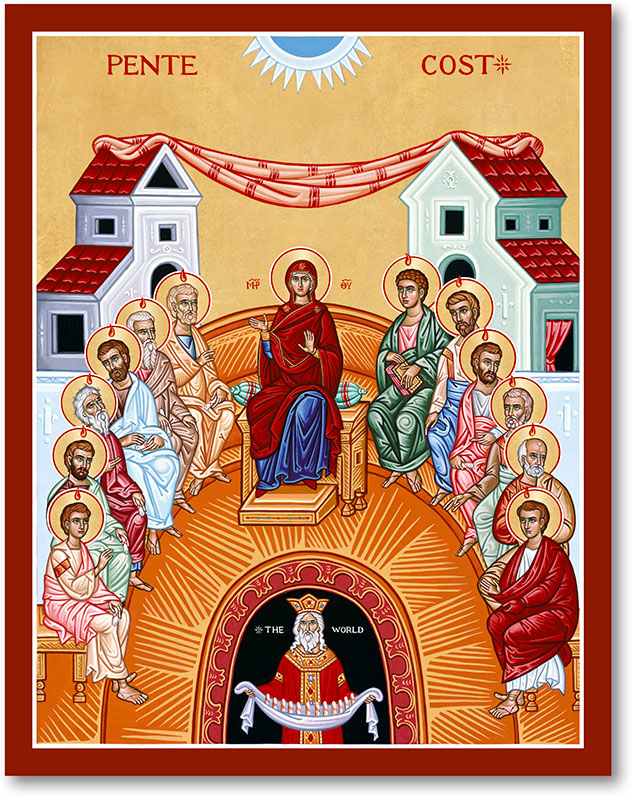
A couple thoughts came up, first Metropolitan Zizioulas paper about comparative theology and “confessional Christianity.” The Orthodox countries were far removed from the conversation of the Reformation and the different confessions of faith that resulted, i.e. Methodists, Prebetyrians, Lutherans, where Christian groups compare their confessions of faith to one another to clarify their positions on an issue like predestination, how much God is involved in saving us or if we have a say and can therefore sabotage our own salvation. In his paper Zizioulas shows that Orthodoxy never thought about their faith as a list of doctrines like denominations do until the last couple centuries;1 rather, since Pentecost the Church knew itself as the Christians of a community who gathered together to celebrate the Heavenly Liturgy. In the early church the deacons, bishops, priests and the rest of the people would gather outside of a parish to enter in together in which they were literally leaving the world and walking into eternity to join the worship of the Kingdom of Heaven centered around the Eucharist, Christ in our midst. Long before any Creed, confession or even Epistle was written, the theology of the early church was shown by their action of participating with Heaven in the Lord’s Supper. That’s a long winded way of saying, “we have been worshipping together since Pentecost and we aren’t used to giving a bunch of statements about why we do what we do, check out the Nicean Creed I guess.”
Next I thought about why the Orthodox Church has never gone to a passage in scripture like Ephesians 1 and asked, “What is our stance on predestination and how should the Church show our stance?” In Orthodoxy this is impossible and would be really jarring to implement. Christ came to the apostles and taught them how to worship, such as when He celebrated the Last Supper with them. After Christ ascended He sent the Holy Spirit to continue teaching the Church how to worship that they might be united to God, Theosis. Saint Paul and the Apostles traveled across the world from Britain to India to baptize and celebrate the liturgy with those who came to Christ. They taught just as Christ taught with spoken words, miracles and gathering the Christians together to worship. Decades later the Apostles wrote Gospels (the good news) and Epistles to the churches they had established and those churches continued to practice what they had been taught by letter and example. The second generation would do the same – Saint Ignatius, Saint Polycarp and Saint Clement would all write pastoral epistles to the same churches as their predecessor Paul, and the Didache records how they baptized and celebrated the Eucharist. We kept doing this from the 100s to today, as Orthodox we would continue to teach our faith through scripture and liturgy and icons and sacraments and preaching; embodying the fullness of the faith we learned from the Apostles. The Orthodox could never say “ok guys now we have to be Bible based” and stay true to the Apostles. Nor could we peruse scripture as a system of propositions in order to trim down the Faith into a set of conclusions that we call “doctrine.”
Then in our amazing conversation Chu astutely asked me why predestination never came up as a topic in the Orthodox world. I suppose it stems from our way of seeing the world. I gave the example of how a Latin, a Greek and a Jew would describe a table in the first century. The Jew would tell you the story of the table: “This was the table of John’s family and it goes back centuries. It was in Babylon and Nehemiah ate off this table.” The Greek would tell you what a table is, the ontology of the table: “A table has four legs and a top.” The Latin would give you the legal description of the table, who owns it and its function: “This is John’s table and you eat off it.” The Orthodox theological discussions in the Greek world centered around the being of God and how we relate to Him and we never found ourselves drawing legal boundaries between the sovereignty of God and the free will of man into a doctrine of predestination. We need all three perspectives – Latin, Jew and Greek just as God is Trinity; Christ told us He did not come to abolish the law but to fulfill it, He came to His people to finish their story of salvation and Saint John the Beloved disciples witness to us that, “We shall be like Him, for we shall see Him as He is” in the fullness of His ontology. (1 John 3:2)
So why do we compare doctrines and ask if Mormons are Christians? What is our goal? We long for communion as our true salvation. As Saint Silouan said, “Love could not abide to abandon the Image of God to Hell, we must pray for all.” To see Christ as He is, is to be united to the God who is love and share in the fullness of communion with Him. Communion is the essence of the Trinity; one united to the Trinity shares in every relationship of the Trinity, whether united together by essence like the Father, Son and Holy Spirit or by grace like His creation. So we ask, “What do you believe?” in hope that we might share communion with the other before us.
What then does it look like to be in communion with Christ and creation? I can only paint that picture with specific people in love with Christ. Saint Simeon waited in the Temple until Christ was placed in his hands and he cried, “Lord my eyes behold You. You release me from bondage and save me.” Saint Ignatius of Antioch begged the church in Rome not to interfere with his martyrdom “pray leave me to be a meal for the beasts, for it is they who can provide my way to God. I am His wheat, ground fine by the lions’ teeth to be made purest bread for Christ. … Suffer me to attain to light, light pure and undefiled; for only when I am come thither shall I be truly a human being.” Salvation looks like the saint united to Christ in His death and resurrected with Him in His Divine life, loving all for God is love.


 Cycles of Newness
Leave a reply to David S Cancel reply